> For the complete documentation index, see [llms.txt](https://docs.nexthink.com/llms.txt). Markdown versions of documentation pages are available by appending `.md` to page URLs; this page is available as [Markdown](https://docs.nexthink.com/platform/ja/user-guide/alerts-and-diagnostics/getting-started-with-diagnostics/high-cpu-usage.md).
# 高CPU使用率
{% hint style="info" %}
Nexthinkは、顧客のニーズをより良く満たすためにその機能を継続的に最適化しています。したがって、新規顧客に対する **高いCPU使用率** ダッシュボードは、グローバルに検出された問題のバイナリ関連洞察を含む、バイナリシステムモニターを優先するため有効化されません。
Nexthinkが **バイナリプロファイリング** および **アラート概要** ダッシュボードからアクセス可能なバイナリ洞察をどのように生成しているかについては、[バイナリプロファイリング](/platform/ja/user-guide/alerts-and-diagnostics/getting-started-with-diagnostics/binary-profiling.md#binary-insights)のドキュメントを参照してください。
{% endhint %}
バイナリに関連する高いCPU使用率の問題を評価し、トラブルシューティングします。
## 高いCPU使用率の概要ページにアクセスするには、
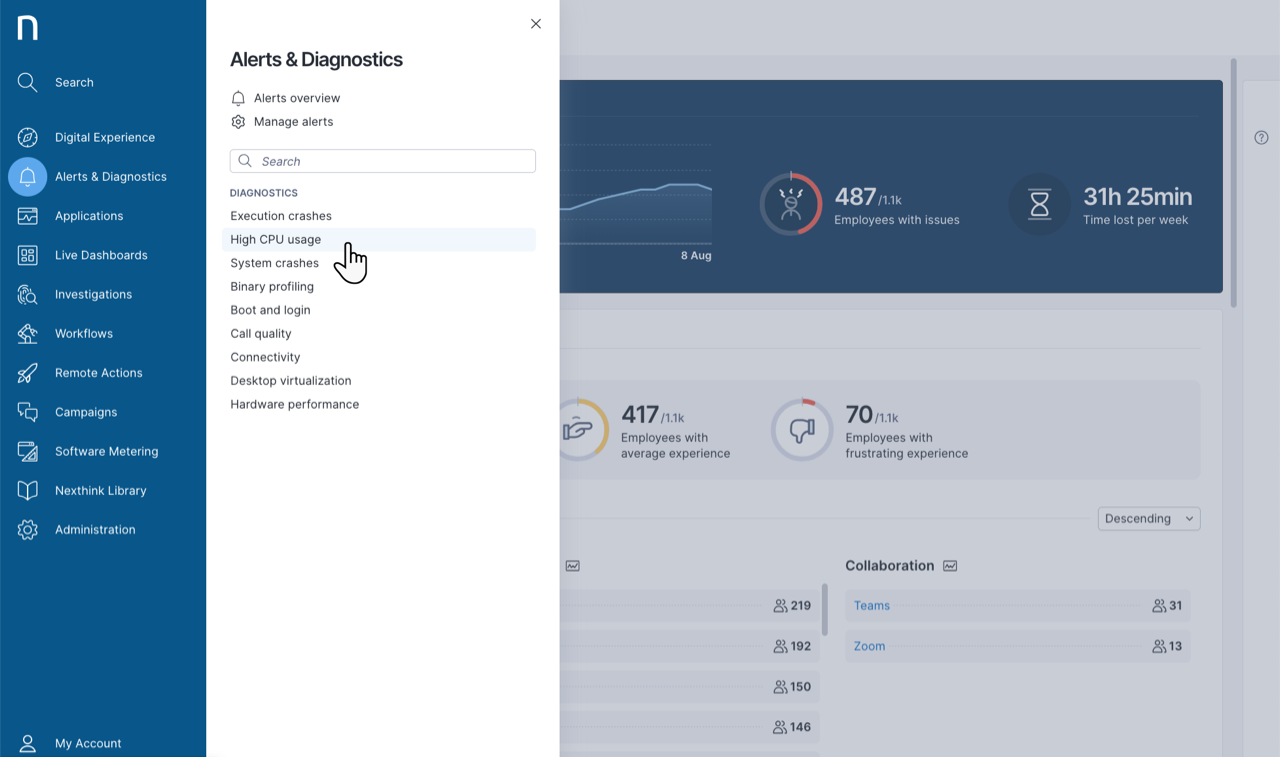
* メインメニューから **アラートと診断** を選択します。
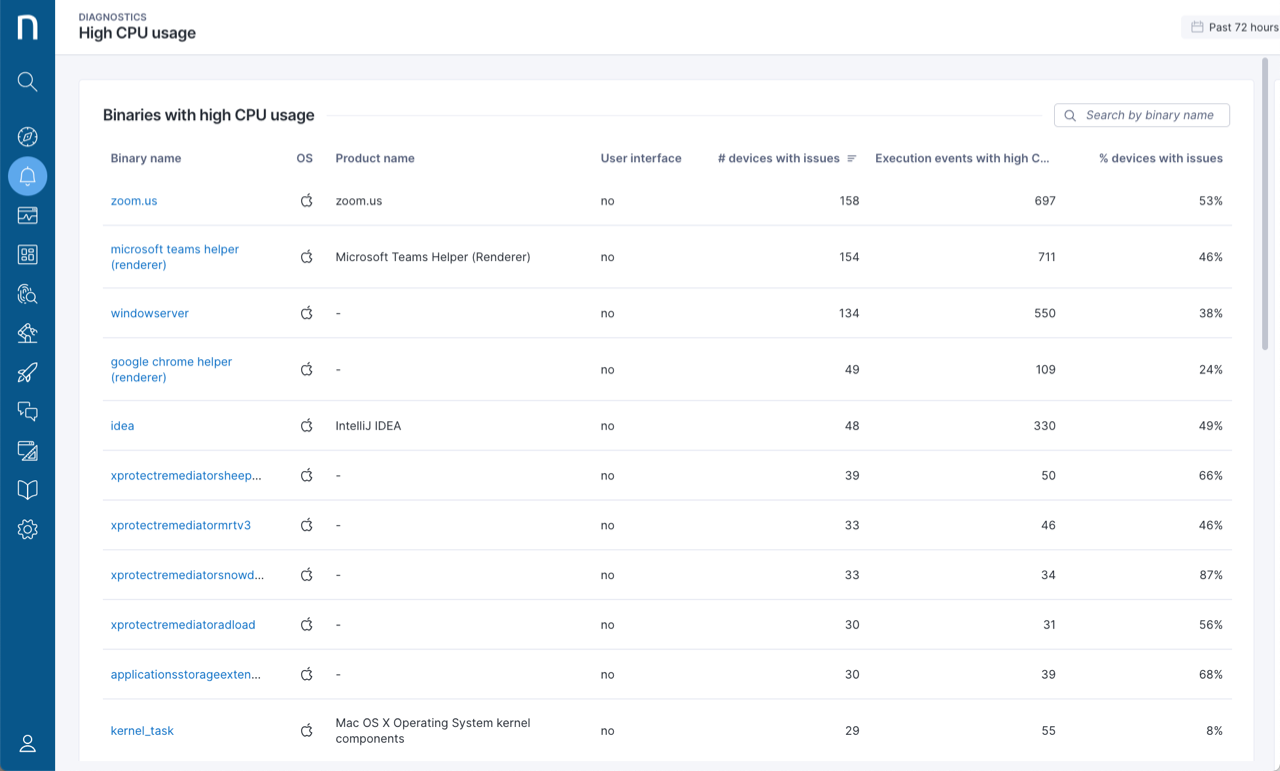
* ナビゲーションパネルから **高いCPU使用率** をクリックします。ページには、過去72時間の高いCPU使用率を持つバイナリが一覧表示されます。
### 高いCPU使用率のバイナリテーブル
特定の問題に焦点を合わせるために、テーブルを検索および並べ替えることができます。
**高いCPU使用率を持つバイナリ** テーブルは次のように整理されています。
* **バイナリ名**: バイナリ名をクリックすると、特定のバイナリに関する高 CPU 使用率の詳細ページにアクセスでき、トラブルシューティングを行うオプションも表示されます。
* **製品名**: バイナリのインベントリに表示される名前と一致する製品名。同じバイナリ名が複数のエントリを持っている場合、Nexthinkは最も一般的なものを選択します。
* **ユーザーインターフェース**: この列はバイナリにユーザーインターフェース (UI) があるかどうかを示します。バックグラウンドで実行される特定のバイナリには、設定UIがある可能性があることに注意してください。この場合、この列には\_はい\_と表示されますが、バイナリがMicrosoft Windowsオペレーティングシステム上で実行されている場合にのみです。
* **問題があるデバイス数**: 過去7日間に少なくとも1回の高負荷のCPUイベントが発生したデバイスの絶対数。
* **高負荷CPUの実行イベント**: 高CPU使用率を記録した実行イベントの絶対数。
* **問題があるデバイスの割合**: 問題があるデバイスの割合。
## 高CPU使用率の詳細ページ
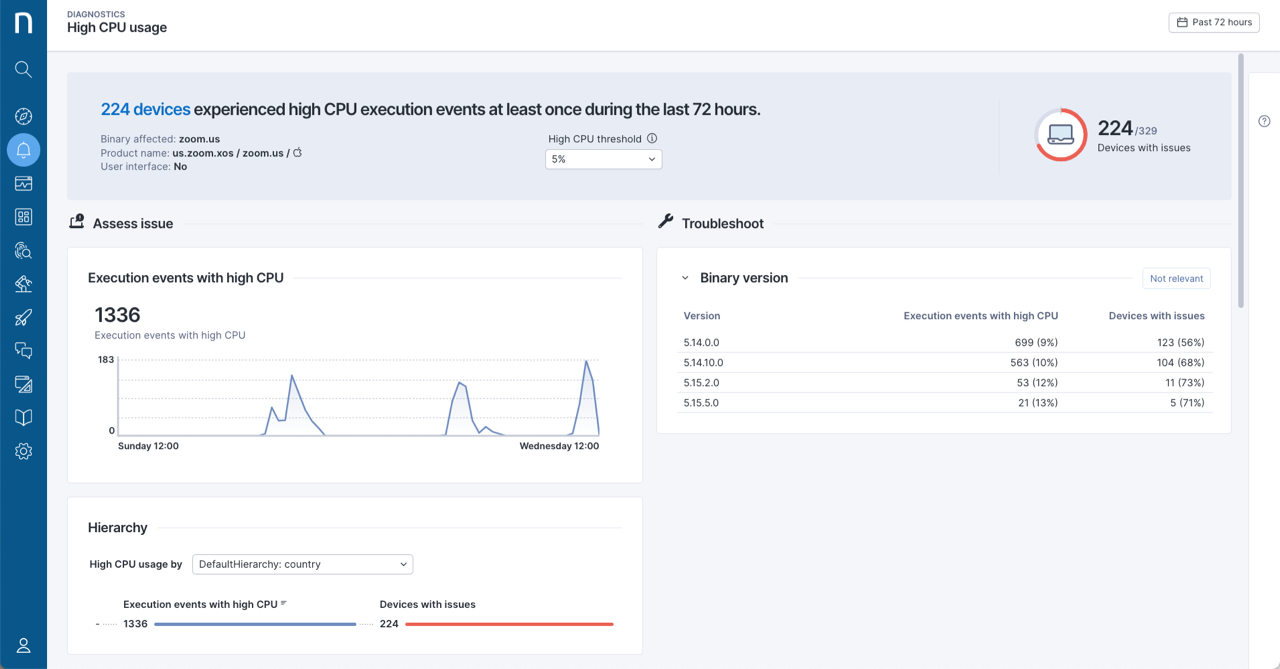
The top banner shows the number of devices that experienced high CPU execution events at least once in the last 72 hours. 影響を受けたバイナリ、製品名、及びユーザーインターフェースがあるかを一覧表示します。
* サマリー内の**デバイス**リンクにより、影響を受けたデバイスの詳細情報が得られるInvestigationsダッシュボードに移動します。
* **High CPU threshold**: Define the percentage of CPU used by the binary over a 15-minute period for it to be considered as high CPU usage. デフォルト値は 5% です。
* **問題のあるデバイス**: 影響を受けたデバイスの数を示します。
## 問題を評価
高CPU使用率のバイナリの文脈と範囲を理解します:
* **高CPU使用率の実行イベント**: 指定された期間の高CPU実行イベントを表示します。右上の期間選択ツールを使用して期間を変更します。
* **階層**: 組織内の階層レベルで結果をフィルタリングします。 This option is available only for users of hierarchies (classic).
* **位置**: 地理的階層で結果をフィルタリングします。このセクションは、ジオロケーション機能が有効になっている場合にのみ表示されます。 Administration モジュールの[製品設定](/platform/ja/user-guide/administration/system-configuration/data-management/environment/product-configuration.md)ページで設定できます。
* **技術的**: **オペレーティングシステム**や**プラットフォーム**などの技術的基準で結果をフィルタリングします。
## トラブルシューティング
### バイナリバージョン
自動的なインサイトは、問題の根本原因を見つけるために関連するバイナリバージョンをチェックします。 AIを用いた判定は、問題に最も関連のある値を赤色で表示します。
* **バージョン**: バイナリのバージョンを表示します。
* **Execution events with high CPU**: View the absolute number of executions marked as *high CPU usage* over a 15-minute period, based on the threshold selected from the dropdown menu at the top of the page.
* **問題のあるデバイス**: バイナリの高CPU使用率が観察されたデバイスの絶対数を表示します。デバイスは、定義された期間内に少なくとも一度は、バイナリが高CPU使用率を示したときに問題があるとみなされます。パーセンテージは、指定されたプロパティ値のみに対して計算されます。
***
関連リンク
* [Diagnosticsの使い始め](/platform/ja/user-guide/alerts-and-diagnostics/getting-started-with-diagnostics.md)
* [製品設定](/platform/ja/user-guide/administration/system-configuration/data-management/environment/product-configuration.md)
---
# Agent Instructions
This documentation is published with GitBook. GitBook is the documentation platform designed so that both humans and AI agents can read, navigate, and reason over technical content effectively. Learn more at gitbook.com.
## Querying This Documentation
If you need additional information that is not directly available in this page, you can query the documentation by asking a question.
Perform an HTTP GET request on the following URL with the `ask` and `goal` query parameters:
```
GET https://docs.nexthink.com/platform/ja/user-guide/alerts-and-diagnostics/getting-started-with-diagnostics/high-cpu-usage.md?ask=&goal=
```
`ask` is the immediate question: it should be specific, self-contained, and written in natural language.
`goal` is what the user is ultimately trying to achieve, the reason they need the answer. Sharing it helps GitBook give you a better, more relevant answer. A goal is most helpful when it describes the outcome the user wants rather than restating the question. For example, with `ask=how do I create an API token`, a goal like `automate deployments from our CI pipeline` lets GitBook tailor the answer to that use case.
The response will contain a direct answer to the question and relevant excerpts and sources from the documentation.
Use this mechanism when the answer is not explicitly present in the current page, you need clarification or additional context, or you want to retrieve related documentation sections.