> For the complete documentation index, see [llms.txt](https://docs.nexthink.com/platform/llms.txt). Markdown versions of documentation pages are available by appending `.md` to page URLs; this page is available as [Markdown](https://docs.nexthink.com/platform/ja/library-packs/network-and-connectivity/wi-fi-diagnostics/configuration-guide-wi-fi-and-ethernet-diagnostics.md).

# 設定ガイド: Wi-Fi とイーサネット診断

{% hint style="warning" %}
このページの構成オプションは[管理者](https://docs.nexthink.com/platform/ja/user-guide/administration/account-management/roles#roles-administration)のみが見ることができます。

ライブラリのコンテンツを標準ユーザーとして使用するには、[使用ガイド: Wi-Fi と Ethernet の診断](/platform/ja/library-packs/network-and-connectivity/wi-fi-diagnostics/usage-guide-wi-fi-and-ethernet-diagnostics.md) を参照してください。
{% endhint %}

## **前提条件** <a href="#documentation-pre-requisites" id="documentation-pre-requisites"></a>

このライブラリパックには、[拡張製品](https://docs.nexthink.com/platform/ja/latest/products)からのコンテンツは含まれていません:

## **含まれるコンテンツと依存関係** <a href="#documentation-contentanddependencies" id="documentation-contentanddependencies"></a>

このライブラリパックには以下のコンテンツと依存関係が含まれています；

<table data-header-hidden><thead><tr><th width="158">コンテンツの種類</th><th width="239">名前</th><th width="211">説明</th><th>依存関係</th></tr></thead><tbody><tr><td><br>ダッシュボード</td><td>Wi-Fi とイーサネットの診断</td><td>これはこのパックのメインコンテンツです。</td><td>DEX エンドポイント関連の指標</td></tr><tr><td>DEX エンドポイント関連の指標</td><td><p>Wi-Fi 信号強度</p><pre class="language-nql_/apigateway/nql-editor"><code class="lang-nql_/apigateway/nql-editor">wifi.signal_strength.avg.rating
</code></pre></td><td>Nexthink のデフォルト値が組織の標準と異なる場合に設定できる、エンドポイント関連の指標です。</td><td>[なし]</td></tr><tr><td>DEX エンドポイント関連の指標</td><td><p>Wi-Fi アップロード速度</p><pre class="language-nql_/apigateway/nql-editor"><code class="lang-nql_/apigateway/nql-editor">wifi.transmission_rate.avg.rating
</code></pre></td><td>Nexthink のデフォルト値が組織の標準と異なる場合に設定できる、エンドポイント関連の指標です。</td><td>[なし]</td></tr><tr><td>DEX エンドポイント関連の指標</td><td><p>Wi-Fi ダウンロード速度</p><pre class="language-nql_/apigateway/nql-editor"><code class="lang-nql_/apigateway/nql-editor">wifi.receive_rate.avg.rating
</code></pre></td><td>Nexthink のデフォルト値が組織の標準と異なる場合に設定できる、エンドポイント関連の指標です。</td><td>[なし]</td></tr></tbody></table>

## "Wi-Fi とイーサネットの診断" パックの設定

{% hint style="info" %}
この提案された設定ステップを適応させて、組織のニーズに応じてコンテンツを編集およびカスタマイズしてください。
{% endhint %}

以下の手順に従って、コンテンツをインストールして設定します。

* 設定前 - [Nexthink Library](https://docs.nexthink.com/platform/latest/library)からライブラリパックコンテンツをインストールします
* [ステップ 1 - エンドポイントの指標 (評価) を設定する](#configuring-remote-action-s)

### **ステップ 1 - エンドポイントの指標 (評価) を設定する**

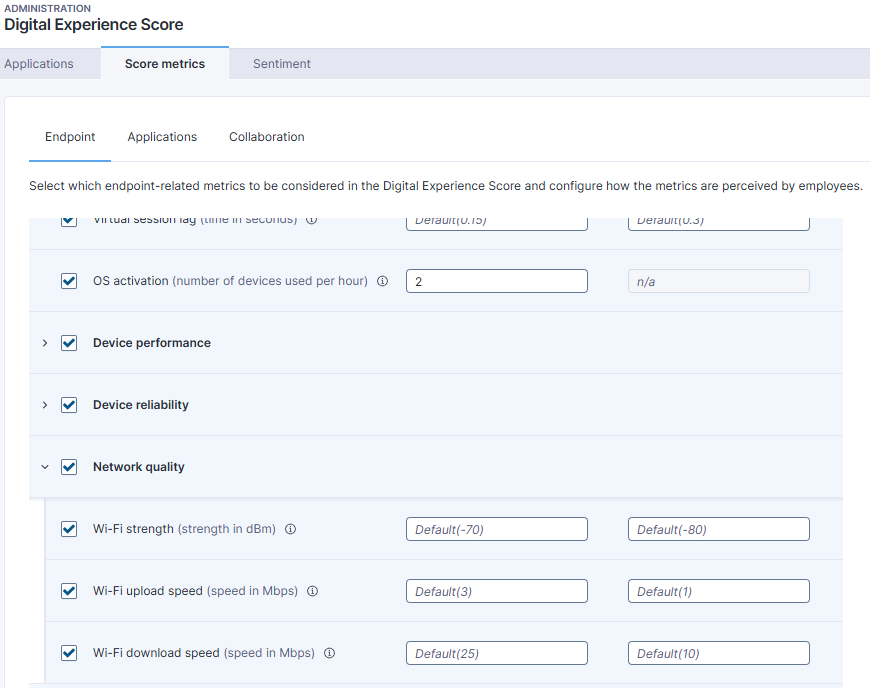
1. メインメニューから、**管理** > コンテンツ管理 > [デジタルエクスペリエンス](https://docs.nexthink.com/platform/ja/latest/manage-remote-actions) ページに移動します。
2. **ネットワークの品質** セクションを展開します。

<figure><img src="/files/Xd4aU6TWZ5KWWU3TOpSF" alt=""><figcaption></figcaption></figure>

3. 各ネットワーク関連の指標について、Nexthink のデフォルトの指標が組織の標準と異なる場合は、必要な閾値を入力してください。
4. これらの新しいエンドポイント指標閾値は、「評価」を使用するすべてのクエリに適用されます。 例えば:

* wifi.signal\_strength.avg.rating = poor の場合
* wifi.transmission\_rate.avg.rating = poor の場合
* wifi.receive\_rate.avg.rating = poor の場合


---

# Agent Instructions
This documentation is published with GitBook. GitBook is the documentation platform designed so that both humans and AI agents can read, navigate, and reason over technical content effectively. Learn more at gitbook.com.

## Querying This Documentation
If you need additional information that is not directly available in this page, you can query the documentation dynamically by asking a question.

Perform an HTTP GET request on the current page URL with the `ask` query parameter, and the optional `goal` query parameter:

```
GET https://docs.nexthink.com/platform/ja/library-packs/network-and-connectivity/wi-fi-diagnostics/configuration-guide-wi-fi-and-ethernet-diagnostics.md?ask=<question>&goal=<endgoal>
```

`ask` is the immediate question: it should be specific, self-contained, and written in natural language.
`goal` is optional and describes the broader end goal you are ultimately trying to accomplish on behalf of the user. GitBook uses it to tailor the answer towards what is most useful for that goal.

The response will contain a direct answer to the question and relevant excerpts and sources from the documentation.

Use this mechanism when the answer is not explicitly present in the current page, you need clarification or additional context, or you want to retrieve related documentation sections.
