> For the complete documentation index, see [llms.txt](https://docs.nexthink.com/llms.txt). Markdown versions of documentation pages are available by appending `.md` to page URLs; this page is available as [Markdown](https://docs.nexthink.com/platform/ja/references/references-classic/tooltips-in-the-user-and-device-views-in-finder-classic/warnings-tooltips-in-finder-classic.md).
# Finder(クラシック)での警告のツールチップ
{% hint style="info" %}
Nexthink FinderはWindows専用のデスクトップアプリケーションで、その機能は現在Nexthinkのwebインターフェース内で利用可能です。 Nexthinkは、ブラウザから直接利用できるようになり、ほとんどの機能が追加のデスクトップアプリケーションを必要としなくなりました。
{% endhint %}
### 高いCPU使用率
{% hint style="info" %}
適用プラットフォーム | Windows | macOS |
{% endhint %}
{% hint style="info" %}
適用プラットフォーム | Windows | macOS |
{% endhint %}
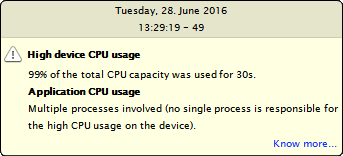
ツールチップは、全体的なCPU使用率が70%以上のときの時間間隔でデバイスのCPU使用率を表示します。ツールチップは2つの形で表示されます:
* デバイスで複数のアプリケーションが高いCPU負荷の原因であり、特定のアプリケーションが原因ではない場合、ツールチップは総CPU使用率のみを表示します。
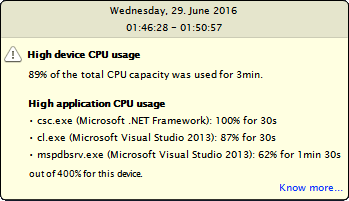
* 特定のアプリケーションがCPU負荷に大きく影響する場合、ツールチップはこれらのアプリケーションとスレッドごとのCPU使用率の詳細を、デバイスでの全体的なCPU使用率に加えて表示します。スレッドごとのCPU使用率は全体のCPU使用率とは異なり、以下のツールチップでさらに詳しく説明されています。
Collectorは30秒ごとにCPU負荷サンプルを取得し、5分ごとに報告します。高いCPU使用率を報告するには、2つ以上の連続したサンプルが70%以上のCPU使用率を超えている必要があります。報告された値は70%以上のサンプルの平均値を表します。
#### 高いアプリケーションCPU使用率
{% hint style="info" %}
適用プラットフォーム | Windows | macOS |
{% endhint %}
\
ツールチップは、選択した時間間隔中にスレッドごとに50%(システムプロセスの場合40%)以上のCPU処理能力を30秒以上消費したプロセス(およびそれに対応するアプリケーション)のリストを表示します。プロセスは、CPU負荷への貢献度の高い順にリストされています。
100%の使用率は、シングルコア、シングルスレッドのCPUの能力に相当します。マルチコアやハイパースレッディング技術を持つCPUでは100%以上の使用率を得ることができます:
* CPUの物理コアが1つ追加されるごとに、100%の処理能力が増加します。例えば、デュアルコアCPUの能力は200%、クアッドコアは400%、ヘックスコアは600%といった具合です。
* CPUがハイパースレッディング技術を使用している場合、各物理コアの処理能力が倍増されます。ハイパースレッディングされたデュアルコアCPUの能力は400%、クアッドコアは800%、ヘックスコアは1200%と続きます。
この測定方法は、デバイスの高いCPU使用率を測定する方法とは異なります。この測定では、CPUの全体的な能力はコアやスレッドの数にかかわらず100%です。この理由から、ツールチップの下部にはハードウェアスレッドに基づくCPUの容量が表示され、これは通常100%を超えます。
### 高いメモリ
{% hint style="info" %}
適用プラットフォーム | Windows | macOS |
{% endhint %}
\
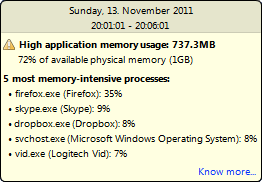
ツールチップは、少なくとも5分間、合計物理メモリの70%以上が使用されている場合に物理メモリの使用状況を表示します。総メモリの1%以上を消費する上位5つのプロセスをリストします。
### 高IOスループット
{% hint style="info" %}
適用プラットフォーム | Windows |
{% endhint %}
{% hint style="info" %}
適用プラットフォーム | Windows |
{% endhint %}
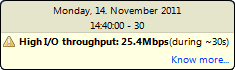
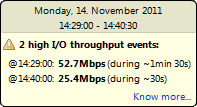
少なくとも30秒間、IO操作が20 MB/s以上の速度で情報を交換するときに警告が表示されます。
総IOスループットは、ハードディスク、フラッシュドライブ、ネットワークコントローラー、キーボード、マウスなどの実際または仮想の周辺機器で行われる読み取り、書き込み、その他のIO操作中に転送されたすべてのバイトを含みます。
### 高いページフォルト
{% hint style="info" %}
適用プラットフォーム | Windows |
{% endhint %}
{% hint style="info" %}
適用プラットフォーム | Windows |
{% endhint %}
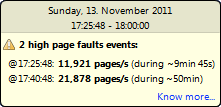
デバイスがメモリアクセスで5分以上にわたり毎秒5000以上のページフォルトを生成するときに警告が表示されます。
***
関連する概念
* [イベント](/platform/ja/references/references-classic/glossary-classic/event-classic.md)
関連する参考文献
* [デバイスと実行に関するエラーと警告](/platform/ja/references/references-classic/search-and-information-display-classic/errors-and-warnings-for-devices-and-executions-with-finder-classic.md)
* [エラーツールチップ](/platform/ja/references/references-classic/tooltips-in-the-user-and-device-views-in-finder-classic/errors-tooltips-in-finder-classic.md)
* [メモリとCPU使用率](/platform/ja/references/references-classic/database-information-and-organization-classic/memory-and-cpu-usage-classic.md)
---
# Agent Instructions
This documentation is published with GitBook. GitBook is the documentation platform designed so that both humans and AI agents can read, navigate, and reason over technical content effectively. Learn more at gitbook.com.
## Querying This Documentation
If you need additional information that is not directly available in this page, you can query the documentation by asking a question.
Perform an HTTP GET request on the following URL with the `ask` and `goal` query parameters:
```
GET https://docs.nexthink.com/platform/ja/references/references-classic/tooltips-in-the-user-and-device-views-in-finder-classic/warnings-tooltips-in-finder-classic.md?ask=&goal=
```
`ask` is the immediate question: it should be specific, self-contained, and written in natural language.
`goal` is what the user is ultimately trying to achieve, the reason they need the answer. Sharing it helps GitBook give you a better, more relevant answer. A goal is most helpful when it describes the outcome the user wants rather than restating the question. For example, with `ask=how do I create an API token`, a goal like `automate deployments from our CI pipeline` lets GitBook tailor the answer to that use case.
The response will contain a direct answer to the question and relevant excerpts and sources from the documentation.
Use this mechanism when the answer is not explicitly present in the current page, you need clarification or additional context, or you want to retrieve related documentation sections.