> For the complete documentation index, see [llms.txt](https://docs.nexthink.com/llms.txt). Markdown versions of documentation pages are available by appending `.md` to page URLs; this page is available as [Markdown](https://docs.nexthink.com/platform/ja/user-guide/administration/system-configuration/data-management/environment/data-management.md).

# データの保持、取得、削除

従業員データを管理し、データ保護規制に準拠します。

## データ保存 <a href="#datamanagement-dataretention" id="datamanagement-dataretention"></a>

組織のNexthinkインスタンスのデータ保存期間を設定します。

<div align="left"><figure><img src="https://3549141153-files.gitbook.io/~/files/v0/b/gitbook-x-prod.appspot.com/o/spaces%2FeLm8O7QKZDn6z806e7Sv%2Fuploads%2Fgit-blob-9fa5712a0b87a00a09ee5cad60bb34a99fc0761d%2F72QMizJeewbxBk7Q.png?alt=media" alt="" width="563"><figcaption></figcaption></figure></div>

### **在庫データ保持**

インベントリデータの保存期間を選択します。この設定は、バイナリを除くすべてのインベントリオブジェクトに適用されます。

データ保存設定を**保存**すると、変更はアクティブなインベントリオブジェクトにのみ適用されます。非アクティブなオブジェクト（新しい設定の保存後にイベントがないオブジェクト）は、元の保存設定を維持し、その元の設定に基づいてシステムから削除されます。

{% hint style="info" %}
NQLの`last_seen`フィールドは、Nexthinkインスタンスへのすべてのデバイス接続（TCPハンドシェイクやリモートアクションなど）を考慮していないため、デバイスの保存期間を示す信頼できる指標ではありません。詳細については、[NQLデータモデル](/platform/ja/understanding-key-data-platform-concepts/nql-data-model.md#device_device)および[デバイス最終アクティビティの監視](https://edocs.nexthink.com/nexthink-infinity/infinity-specifications/monitoring-device-last-activity)を参照してください。
{% endhint %}

### **運用データ保持**

運用データの保存期間を選択します。この設定は、従業員デバイスから収集されたイベント、アラートモニターによってトリガーされたアラート、リモートアクションの実行、およびバイナリに適用されます。運用データの保存期間は、インベントリデータの保存期間以下である必要があります。

データ保存設定を**保存**すると、システムはすべての新しいイベントとすべてのアクティブなバイナリに変更を適用します。

{% hint style="info" %}
データカテゴリと保存期間の詳細については、[収集および保存するデータ](/platform/ja/understanding-key-data-platform-concepts/data-we-collect-and-store.md)および[データ解像度と保存](/platform/ja/understanding-key-data-platform-concepts/data-resolution-and-retention.md)のドキュメントを参照してください。
{% endhint %}

## データ取得 <a href="#datamanagement-dataretrieval" id="datamanagement-dataretrieval"></a>

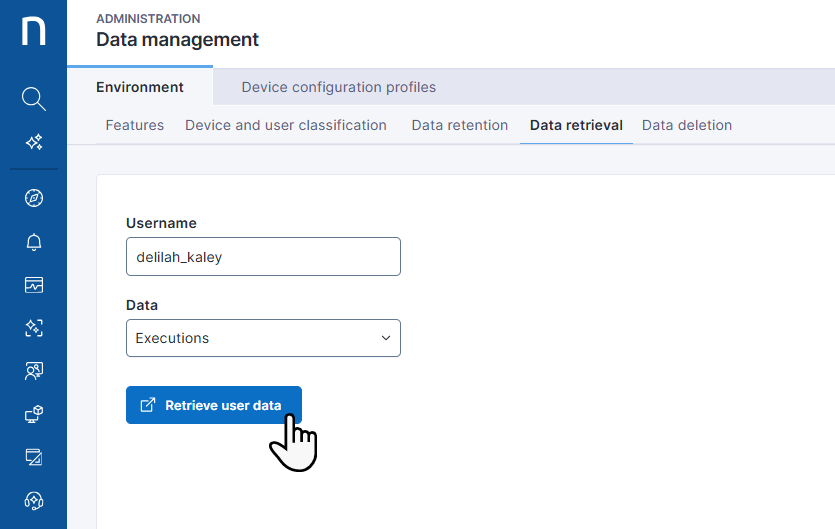
**データ**ドロップダウンメニューに一覧表示される機能およびモジュールについて、Nexthinkプラットフォームで監視されている任意の従業員のデータを取得できます。その他すべての従業員データは、Investigationsモジュールを使用して直接取得します。

<div align="left"><figure><img src="https://3549141153-files.gitbook.io/~/files/v0/b/gitbook-x-prod.appspot.com/o/spaces%2FeLm8O7QKZDn6z806e7Sv%2Fuploads%2Fgit-blob-54b2e013949f9eeb590c0222f472f4ca2fe89dab%2FD9tFPaxTHxKJhjH8.png?alt=media" alt="" width="563"><figcaption></figcaption></figure></div>

* **ユーザー名:** データをダウンロードする従業員のユーザー名を入力します。
* **データ：** データのダウンロード元となる機能またはモジュールを選択します：
  * 実行
  * セッション
  * \[アプリケーション]
  * 協力
  * キャンペーン

**ユーザーデータを取得**ボタンをクリックします。システムにより、NQLクエリの結果を含むInvestigationsページが開きます。結果はCSV形式でエクスポートできます。

## データ削除 <a href="#datamanagement-datadeletion" id="datamanagement-datadeletion"></a>

Nexthinkでは、デバイスおよびユーザーデータを削除するために、以下の方法を提供しています：

* **削除**ページでCSVファイルを使用する
* Data management APIを使用する

{% hint style="info" %}
この動作は、APIベースの削除とCSVアップロードを使用した削除の両方に適用されます。
{% endhint %}

### CSVファイルを使用した削除

<figure><img src="https://3549141153-files.gitbook.io/~/files/v0/b/gitbook-x-prod.appspot.com/o/spaces%2FeLm8O7QKZDn6z806e7Sv%2Fuploads%2Fgit-blob-6abf7b5f01489a7db7faa7d5976f38440392bedc%2FVA81QOwCC8GGMU0e.png?alt=media" alt=""><figcaption></figcaption></figure>

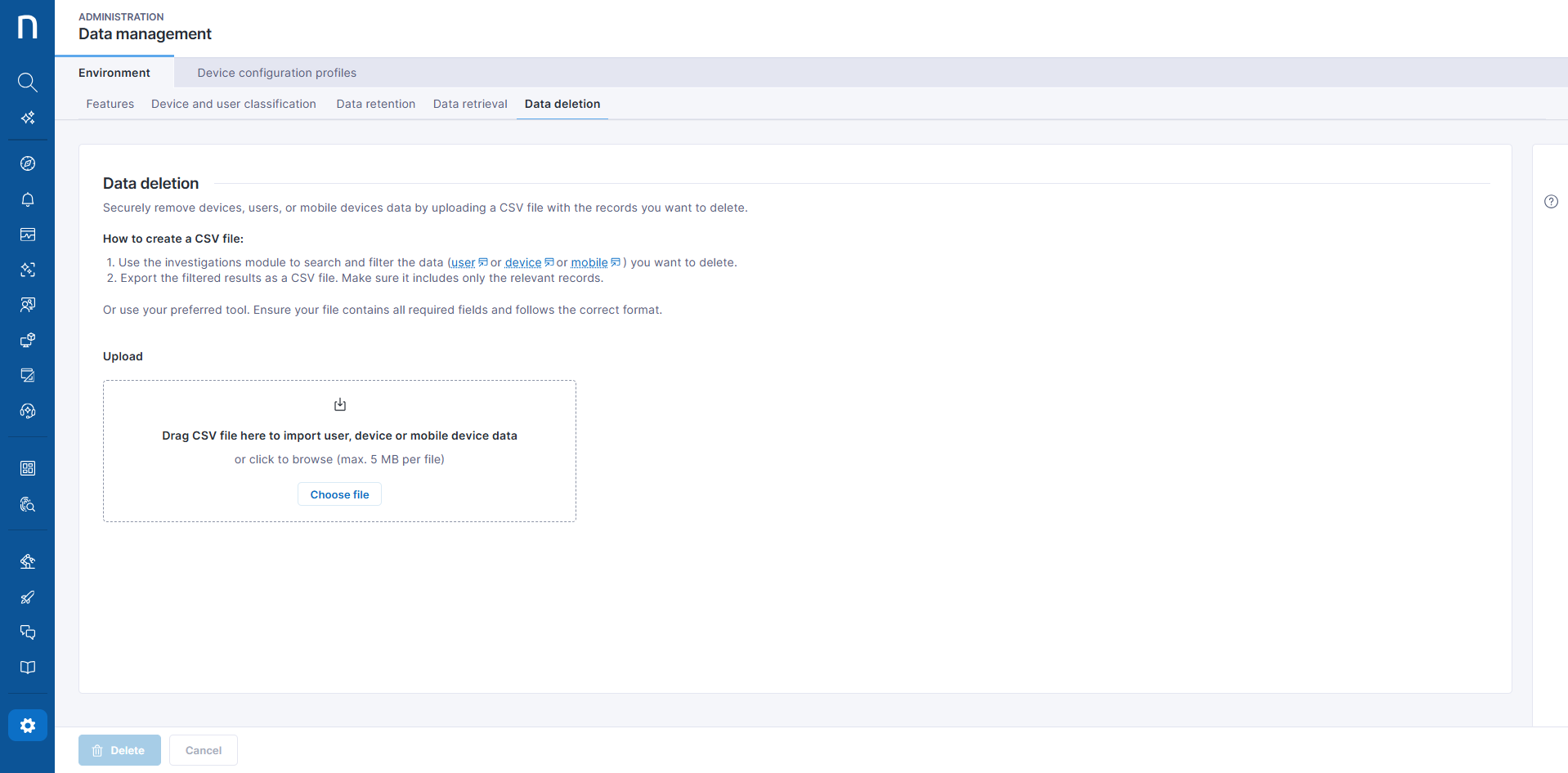
Nexthinkクラウドからデバイスまたはユーザーを削除するには、以下のいずれかを含むCSVファイルを準備します：

* 削除する**ユーザー**のリスト
* 削除する**デバイス**（デスクトップ、ノートPC、VM）のリスト
* 削除する**モバイルデバイス**のリスト

{% hint style="info" %}
CSVファイルには、ユーザー、デバイス、またはモバイルデバイスのいずれか単一の種類のオブジェクトのみを含めてください。複数のオブジェクトタイプを削除するには、タイプごとに別々のCSVファイルを作成してアップロードします。
{% endhint %}

***

#### CSVファイルの作成

CSVファイルには、以下の列を含める必要があります：

* **ユーザー**のUIDおよびSID

例:

```csv
"user.uid","user.sid"
"03c59c0c-7e0e-4fc8-b473-7d4e80ec0eb5","S-1-5-19-xxxxxxxxxx"
"00dbc8e4-593d-42aa-a871-531aceaefc71","S-1-5-20-xxxxxxxxxx"
```

* 対応するデバイス名を含む**デバイス**のUID

例:

```csv
"device.name","device.uid"
"KAN-AMSTERDAM-OWV2DZ","c4b2dfeb-c7c2-403a-9a00-152a95f29d7c"
"KAN-AMSTERDAM-4RSOGR","6e424abd-ab2c-4666-ba03-306848a801fd"
```

* 対応するデバイス名を含む**モバイルデバイス**のUID

例:

```csv
"device.mobile_device.name","device.mobile_device.uid"
"MOBILE-LOS-ANGELES-4FUA5T","095da4a3-f8ee-0b57-77a7-93a5ffaf4402"
"MOBILE-NEW-YORK-3NLY25","0aa5a5a1-c64c-9635-ea40-5c621ce3c7ee"
```

{% hint style="warning" %}
CSVファイルが正しい形式であることを確認してください。エンコードの問題、余分な文字、ヘッダーの誤記、または不正なIDがないか確認してください。不明な場合は、[Investigationsを使用してCSVファイルを生成](#generate-csv-file-using-investigations)してください。
{% endhint %}

***

#### Investigationsを使用したCSVファイルの生成

Nexthinkでは、**Investigations**モジュールからデバイスまたはユーザーを取得してCSVファイルを生成することを推奨しています：

* ページに表示されるリンク（**ユーザー**、**デバイス**、または**モバイル**）を使用して、事前設定済みのクエリから開始します。
* 必要なフィルターを適用してクエリを絞り込み、削除するデバイスまたはユーザーのみを取得します。
* [調査結果を**エクスポート**](/platform/ja/user-guide/investigations/managing-investigations.md#exporting-investigation-results)して、CSVファイルを生成します。

{% hint style="warning" %}
Investigationsで匿名化されていないCSVを生成するには、割り当てられたロールで**ユーザー**および/または**デバイス**の[データプライバシー](/platform/ja/user-guide/administration/account-management/roles.md#roles-dataprivacy)が**表示可能**に設定されている必要があります。
{% endhint %}

***

#### CSVファイルのアップロード

CSVファイルをアップロードするには、アップロード領域にファイルをドラッグするか、**ファイルを選択**をクリックしてコンピューターを参照します。 CSVファイルを生成してアップロードしたら、**削除**ボタンをクリックしてプロセスを開始します。

{% hint style="warning" %}
削除プロセスを開始すると、元に戻すことはできません。
{% endhint %}

<div align="left"><figure><img src="https://3549141153-files.gitbook.io/~/files/v0/b/gitbook-x-prod.appspot.com/o/spaces%2FeLm8O7QKZDn6z806e7Sv%2Fuploads%2Fgit-blob-39de7ab5d00a47d8cd2ac095012789951362f21d%2Fimage%20(1010).png?alt=media" alt="" width="563"><figcaption></figcaption></figure></div>

{% hint style="info" %}
対応するCollectorをアンインストールせずにデバイスを削除すると、そのデバイスは12時間以内に新しいUIDで登録され、Nexthinkはそのデバイスに関連するデータの記録を再び開始します。削除後から新しい登録までの間に送信されたデータは破棄されます。
{% endhint %}

データ削除は通常、30分以内に処理されます。ただし、まれに処理に最大12時間かかる場合があります。

***

#### データの匿名化（クラシック）

このセクションで説明する一部の機能は、Finder（クラシック）に関連しています。

Nexthinkでは、従業員またはデバイスを参照しないようにデータを匿名化できます。

{% hint style="info" %}
Nexthink FinderはWindows専用のデスクトップアプリケーションで、その機能は現在Nexthink Webインターフェイス内で利用できます。 Nexthinkはブラウザーから直接使用できるようになり、ほとんどの機能で追加のデスクトップアプリケーションは不要になりました。
{% endhint %}

<div align="left"><figure><img src="https://3549141153-files.gitbook.io/~/files/v0/b/gitbook-x-prod.appspot.com/o/spaces%2FeLm8O7QKZDn6z806e7Sv%2Fuploads%2Fgit-blob-a9f5bd4412357f3be2cde743c018a042909b4259%2FData_anonymization_classic%20(1).png?alt=media" alt="" width="563"><figcaption></figcaption></figure></div>

次のオプションから選択します：

* **ユーザー**: システムは関連するすべてのフィールドを\_null\_に設定します。
* **デバイス**: システムは関連するすべてのフィールドを\_null\_に設定します。
* 前の手順で選択したオプションに応じて、**ユーザー名**または**デバイス名**を入力します。

**ユーザーデータを匿名化**または**デバイスデータを匿名化**ボタンをクリックして、プロセスを開始します。

{% hint style="info" %}
匿名化プロセスを開始すると、システムはストレージレベルで値を匿名化するため、元に戻すことはできません。
{% endhint %}

### Data management APIを使用した削除

これを使用してデバイスを削除する方法の詳細については、[Data management API](https://docs.nexthink.com/api/data-management)のドキュメントを参照してください。

データ削除は通常、30分以内に処理されます。ただし、まれに処理に最大12時間かかる場合があります。

***

関連トピック

* [データ解像度と保存](/platform/ja/understanding-key-data-platform-concepts/data-resolution-and-retention.md)
* [ロール](/platform/ja/user-guide/administration/account-management/roles.md)


---

# Agent Instructions
This documentation is published with GitBook. GitBook is the documentation platform designed so that both humans and AI agents can read, navigate, and reason over technical content effectively. Learn more at gitbook.com.

## Querying This Documentation
If you need additional information that is not directly available in this page, you can query the documentation by asking a question.

Perform an HTTP GET request on the following URL with the `ask` and `goal` query parameters:

```
GET https://docs.nexthink.com/platform/ja/user-guide/administration/system-configuration/data-management/environment/data-management.md?ask=<question>&goal=<user_goal>
```

`ask` is the immediate question: it should be specific, self-contained, and written in natural language.
`goal` is what the user is ultimately trying to achieve, the reason they need the answer. Sharing it helps GitBook give you a better, more relevant answer. A goal is most helpful when it describes the outcome the user wants rather than restating the question. For example, with `ask=how do I create an API token`, a goal like `automate deployments from our CI pipeline` lets GitBook tailor the answer to that use case.

The response will contain a direct answer to the question and relevant excerpts and sources from the documentation.

Use this mechanism when the answer is not explicitly present in the current page, you need clarification or additional context, or you want to retrieve related documentation sections.