> For the complete documentation index, see [llms.txt](https://docs.nexthink.com/platform/llms.txt). Markdown versions of documentation pages are available by appending `.md` to page URLs; this page is available as [Markdown](https://docs.nexthink.com/platform/ja/user-guide/alerts-and-diagnostics/getting-started-with-alerts.md).
# アラートの操作
アラートは、ITサポートチームがプロアクティブに取り組むうえで不可欠な要素です。アラートにより、チームは問題を検出し、デジタル従業員Experience(DEX)の向上に向けた取り組みの優先順位付けを行えます。
***
## モニターとアラートとは?
**モニター**とは、システムクラッシュ、ロード時間、接続失敗などの定義済みの条件またはパフォーマンス指標に対して、メトリックを定期的に評価するように設定するルールです。
* モニターは、定義された条件が満たされるとアラートをトリガーします。
* モニターは、カスタム作成することも、組み込みのモニター(システムモニターまたはNexthink Libraryからインストールしたモニター)を使用することもできます。
したがって、**アラート**は、モニターがIT環境内の問題または異常を検出した結果です。
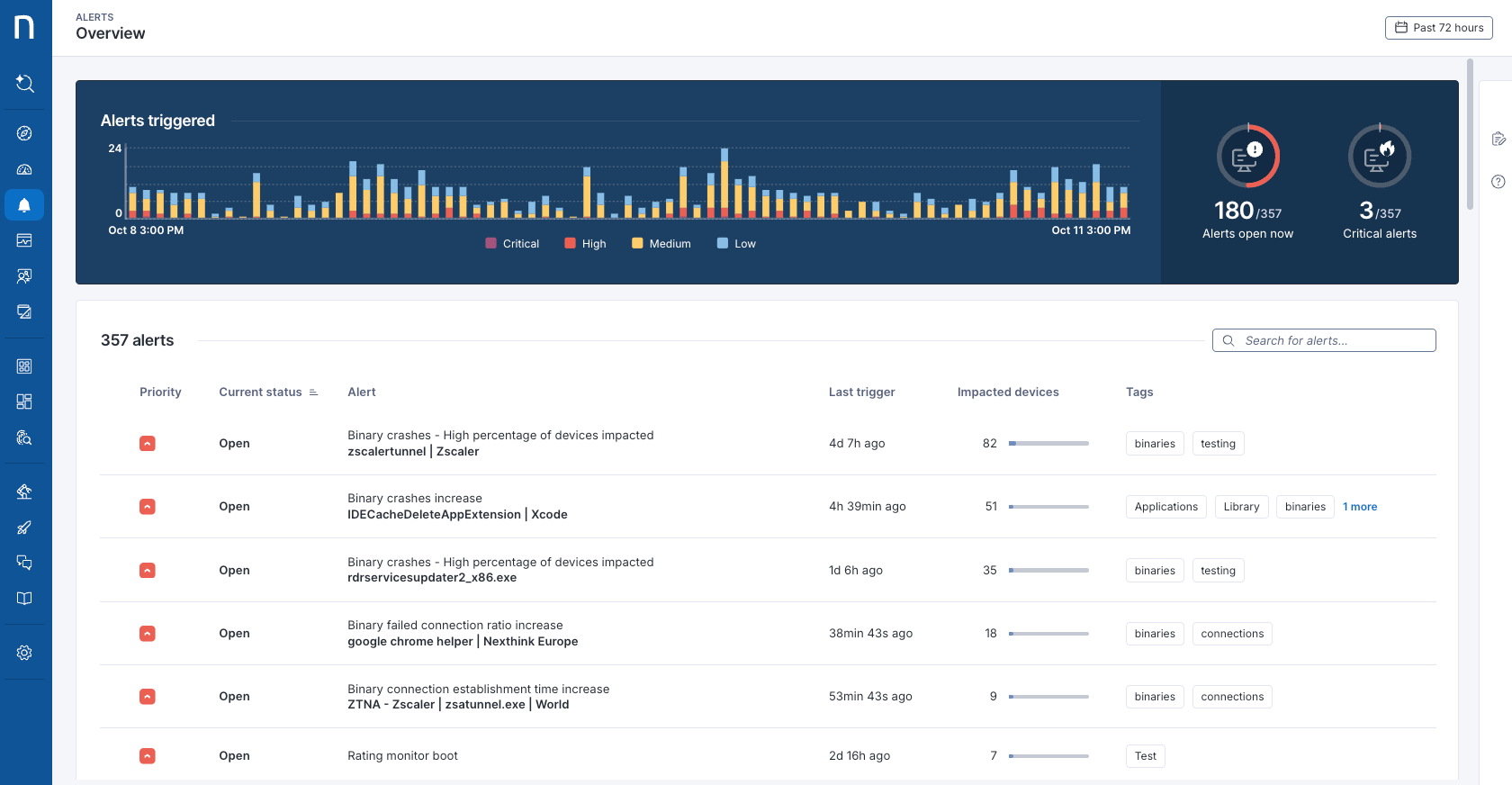
* トリガーされたアラートは、[アラートの概要](/platform/ja/user-guide/alerts-and-diagnostics/getting-started-with-alerts/responding-to-alerts/alerts-overview.md)のタイムラインに表示されます。
* 設定されている場合、トリガーされたアラートはメールまたはwebhook通知を有効にし、組織内に問題を通知します。
* アラートは、メトリック値が安定し、後続の評価によってクローズされるまでオープンのままです。
{% hint style="info" %}
アラートをオープンおよびクローズするロジックの詳細については、[アラートFAQ](/platform/ja/user-guide/alerts-and-diagnostics/alerts-faq.md#how-does-the-system-determine-when-to-close-alerts)を参照してください。
さらに、モニターの設定およびカスタマイズについては、[アラートの管理](/platform/ja/user-guide/alerts-and-diagnostics/setting-up-and-managing-monitors/managing-alerts.md)ドキュメントを参照してください。
{% endhint %}
## アラートはどのように問題を検出し、診断に役立つのですか?
アラートは、迅速な対応と実際のユーザー介入を必要とする問題、つまり予期せず何かが変更された、または発生した状況を通知します。
アラートの問題検出では、検出の粒度を調整し、単一の障害から広範囲に及ぶインシデントまで、影響を受けたユーザーやデバイスを特定できます。
環境に影響を及ぼすグローバルな問題を検出する
Alertsの**クラウドインサイト**を使用して、組織全体の統計に基づきNexthinkが特定した、環境に影響を及ぼす問題を検出します
* バイナリの信頼性とパフォーマンスを把握し、異常なCPU使用率などの異常を検出します。
* 影響を受けているバイナリバージョンを迅速に特定し、推奨バージョンを確認します。
{% hint style="info" %}
アラートを監視し、診断目的で使用する方法については、[アラートの概要](/platform/ja/user-guide/alerts-and-diagnostics/getting-started-with-alerts/responding-to-alerts/alerts-overview.md)を参照してください。
{% endhint %}
デバイス全体で頻発する問題を検出する
複数のデバイスにわたる任意のメトリック値を監視し、集計されたメトリック値が定義されたしきい値を超えたか、または特定の割合で変化したかを検出します。
たとえば、過去7日間のメトリック値の平均など、事前定義された基準と比較して任意のバイナリのクラッシュ数が100%増加すると、システムはアラートをトリガーします。
詳細については、[複数のデバイスに影響する問題の検出](/platform/ja/user-guide/alerts-and-diagnostics/setting-up-and-managing-monitors/creating-custom-monitors/detecting-issues-impacting-multiple-devices.md)を参照してください。
問題が発生している特定のエンドポイントデバイス、モバイルデバイス、またはユーザーを検出する
単一のデバイスまたは特定のユーザーの問題を監視し、該当する場合にアラートをトリガーします。デバイスまたはユーザーごとに個別の通知を送信します。
たとえば、過去24時間以内に少なくとも2回のシステムクラッシュが発生したデバイスごとに、システムがアラートをトリガーし、ユーザーに代わってITSMソフトウェアにチケットを作成します。
詳細については、[単一のデバイスまたはユーザーに影響する問題の検出](https://docs.nexthink.com/platform/ja/user-guide/alerts-and-diagnostics/managing-alerts/creating-custom-monitors/detecting-issues-impacting-a-single-device-or-user)ドキュメントを参照してください。
問題が発生しているエンドポイントデバイス、モバイルデバイス、またはユーザーの数を検出する
一定数のデバイスまたはユーザーで問題が発生したかどうかを検出します。
たとえば、過去24時間以内に起動時間が60秒を超えたデバイスが20台を超えると、システムはアラートをトリガーします。
{% hint style="info" %}
NQLクエリを使用して、既存のアラートに関連付けられたモバイルを含むデバイスを調査する方法については、[アラートFAQ](/platform/ja/user-guide/alerts-and-diagnostics/alerts-faq.md#how-can-i-investigate-and-query-devices-associated-with-an-existing-alert)を参照してください。
{% endhint %}
## システムはどのようにアラートをトリガーおよびクローズしますか?
Nexthinkのモニターは、定義済みの条件またはパフォーマンス指標に対してメトリックを定期的に評価することで、アラートをトリガーします。
この継続的な評価は定期的な間隔でスケジュールすることも、リアルタイム監視用に設定することもでき、問題を即座に検出して、しきい値を超過している時間を示します。
トリガー方法にかかわらず、モニターは新しいアラートをオープンするか、現在のアラートを**オープン**のままにするか、またはクローズするかを判断します。
アラートは、メトリック値が安定し、後続の評価によってクローズされるまでオープンのままです。
{% hint style="info" %}
アラートをオープンおよびクローズするロジックの詳細については、[アラートFAQ](/platform/ja/user-guide/alerts-and-diagnostics/alerts-faq.md#how-does-the-system-determine-when-to-close-alerts)を参照してください。
{% endhint %}
## すぐに使用できるモニターはありますか?
Nexthink Alerts and Diagnosticを初めて開くと、最も一般的な問題についてIT環境を追跡するために、システムはデフォルトで組み込みモニターを有効にします。これらのモニターは、好みに合わせてカスタマイズできます。
{% hint style="info" %}
参照:
* [組み込みモニターのカスタマイズ](/platform/ja/user-guide/alerts-and-diagnostics/setting-up-and-managing-monitors/customizing-built-in-monitors.md):設定に関する詳細情報
* 利用可能なシステムモニターについては、[モニターの設定と管理](/platform/ja/user-guide/alerts-and-diagnostics/setting-up-and-managing-monitors.md#system-and-nexthink-library-monitors)を参照してください。
{% endhint %}
***
関連トピック
* [アラートへの対応](/platform/ja/user-guide/alerts-and-diagnostics/getting-started-with-alerts/responding-to-alerts.md)
* [アラートの管理](/platform/ja/user-guide/alerts-and-diagnostics/setting-up-and-managing-monitors/managing-alerts.md)
---
# Agent Instructions
This documentation is published with GitBook. GitBook is the documentation platform designed so that both humans and AI agents can read, navigate, and reason over technical content effectively. Learn more at gitbook.com.
## Querying This Documentation
If you need additional information that is not directly available in this page, you can query the documentation by asking a question.
Perform an HTTP GET request on the following URL with the `ask` and `goal` query parameters:
```
GET https://docs.nexthink.com/platform/ja/user-guide/alerts-and-diagnostics/getting-started-with-alerts.md?ask=&goal=
```
`ask` is the immediate question: it should be specific, self-contained, and written in natural language.
`goal` is what the user is ultimately trying to achieve, the reason they need the answer. Sharing it helps GitBook give you a better, more relevant answer. A goal is most helpful when it describes the outcome the user wants rather than restating the question. For example, with `ask=how do I create an API token`, a goal like `automate deployments from our CI pipeline` lets GitBook tailor the answer to that use case.
The response will contain a direct answer to the question and relevant excerpts and sources from the documentation.
Use this mechanism when the answer is not explicitly present in the current page, you need clarification or additional context, or you want to retrieve related documentation sections.