> For the complete documentation index, see [llms.txt](https://docs.nexthink.com/llms.txt). Markdown versions of documentation pages are available by appending `.md` to page URLs; this page is available as [Markdown](https://docs.nexthink.com/user-guide/live-dashboards/widget-types/table.md).
# Table
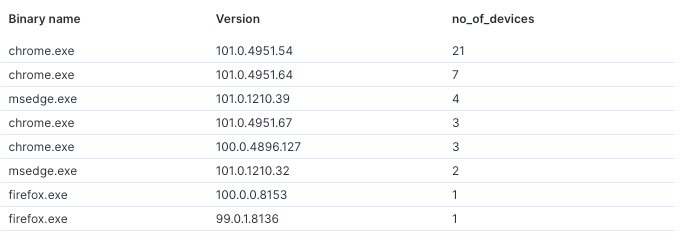
Any valid NQL query can power a table. It is similar to running a query on the Investigations page.
## Configuring visualization fields specific to table charts
{% hint style="info" %}
Refer to the [Managing Live Dashboards](/user-guide/live-dashboards/managing-live-dashboards.md#filling-in-widget-visualization-fields) documentation to learn how to fill in the remaining configuration fields that are not specific to this widget.
{% endhint %}
After selecting the **Multi metric gauge chart** option from the **Chart type** dropdown in the [Add widget](/user-guide/live-dashboards/managing-live-dashboards.md#adding-widgets)/[Edit a widget](/user-guide/live-dashboards/managing-live-dashboards.md#managing-widgets) pop-up:
1. Give the widget a **Title (optional)**.
2. Enter a **Widget description (optional)** to explain, for example, how the metric should be interpreted, calculated, or any subtleties to the metric.
* The widget description appears by hovering over the info icon next to the bar chart widget in the dashboard.
3. Define the **Maximum number of rows to be displayed** in the container.
* The dashboard displays a **Load more** button if the table results exceed the defined limit.
## Obtaining binary descriptions from table-type widgets
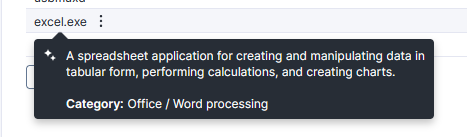
Hover over named binaries displayed in [Live Dashboards](/user-guide/live-dashboards/using-live-dashboards.md#usinglivedashboards-usingdashboardwidgets) table-type widgets to obtain an AI-generated description of specific binaries.
These descriptions attempt to attribute a category to the binary, providing additional context related to functionality.
Tables are great for listing multiple aggregations or individual objects.
## Data shape
Any valid NQL query can power a table. It is similar to running a query on the Investigations page.
## NQL structure
```
Any valid NQL query
```
## Configuring visualization fields specific to table charts
{% hint style="info" %}
Refer to the [Managing Live Dashboards](/user-guide/live-dashboards/managing-live-dashboards.md#filling-in-widget-visualization-fields) documentation to learn how to fill in the remaining configuration fields that are not specific to this widget.
{% endhint %}
After selecting the **Multi metric gauge chart** option from the **Chart type** dropdown in the [Add widget](/user-guide/live-dashboards/managing-live-dashboards.md#adding-widgets)/[Edit a widget](/user-guide/live-dashboards/managing-live-dashboards.md#managing-widgets) pop-up:
1. Give the widget a **Title (optional)**.
2. Enter a **Widget description (optional)** to explain, for example, how the metric should be interpreted, calculated, or any subtleties to the metric.
* The widget description appears by hovering over the info icon next to the bar chart widget in the dashboard.
3. Define the **Maximum number of rows to be displayed** in the container.
* The dashboard displays a **Load more** button if the table results exceed the defined limit.
## Obtaining binary descriptions from table-type widgets
Hover over named binaries displayed in [Live Dashboards](/user-guide/live-dashboards/using-live-dashboards.md#usinglivedashboards-usingdashboardwidgets) table-type widgets to obtain an AI-generated description of specific binaries.
These descriptions attempt to attribute a category to the binary, providing additional context related to functionality.
***
RELATED TOPIC
* [KPI](/user-guide/live-dashboards/widget-types/kpi.md)
* [Line chart](/user-guide/live-dashboards/widget-types/line-chart.md)
* [Bar chart](/user-guide/live-dashboards/widget-types/bar-chart.md)
* [Single-metric gauge chart](/user-guide/live-dashboards/widget-types/single-metric-gauge-chart.md)
* [Multi-metric gauge chart](/user-guide/live-dashboards/widget-types/multi-metric-gauge-chart.md)
* [Heading](/user-guide/live-dashboards/widget-types/heading.md)
* [Filter widget](/user-guide/live-dashboards/widget-types/filter-widget.md)
* [Timeframe picker](/user-guide/live-dashboards/widget-types/timeframe-picker.md)
---
# Agent Instructions
This documentation is published with GitBook. GitBook is the documentation platform designed so that both humans and AI agents can read, navigate, and reason over technical content effectively. Learn more at gitbook.com.
## Querying This Documentation
If you need additional information that is not directly available in this page, you can query the documentation by asking a question.
Perform an HTTP GET request on the following URL with the `ask` and `goal` query parameters:
```
GET https://docs.nexthink.com/user-guide/live-dashboards/widget-types/table.md?ask=&goal=
```
`ask` is the immediate question: it should be specific, self-contained, and written in natural language.
`goal` is what the user is ultimately trying to achieve, the reason they need the answer. Sharing it helps GitBook give you a better, more relevant answer. A goal is most helpful when it describes the outcome the user wants rather than restating the question. For example, with `ask=how do I create an API token`, a goal like `automate deployments from our CI pipeline` lets GitBook tailor the answer to that use case.
The response will contain a direct answer to the question and relevant excerpts and sources from the documentation.
Use this mechanism when the answer is not explicitly present in the current page, you need clarification or additional context, or you want to retrieve related documentation sections.