> For the complete documentation index, see [llms.txt](https://docs.nexthink.com/platform/llms.txt). Markdown versions of documentation pages are available by appending `.md` to page URLs; this page is available as [Markdown](https://docs.nexthink.com/platform/library-packs/network-and-connectivity/wi-fi-diagnostics/usage-guide-wi-fi-and-ethernet-diagnostics.md).
# Usage guide: Wi-Fi and Ethernet diagnostics
{% hint style="warning" %}
This page outlines various ways to use the pack, including use case examples.
Administrators can refer to the [Configuration guide: Wi-Fi and ethernet diagnostics](/platform/library-packs/network-and-connectivity/wi-fi-diagnostics/configuration-guide-wi-fi-and-ethernet-diagnostics.md) to set up and customize the installed content.
{% endhint %}
The **Wi-Fi and Ethernet diagnostics** library pack enables EUC teams to:
* Identify key connectivity metrics to aid in the rapid diagnosis of connectivity issues
* Monitor key network diagnostic and performance measures for devices connected by Wi-Fi and Ethernet
## Library pack uses
{% hint style="info" %}
Jump to [Use cases](#use-cases) on this page to see relevant scenario applications.
{% endhint %}
Use the library pack content for the following purposes.
### **Visibility**
The **Wi-Fi and Ethernet diagnostics** [live dashboard](https://docs.nexthink.com/platform/latest/live-dashboards) is the starting point of this library pack. It provides visibility into your network connectivity landscape to easily monitor and uncover any issues and/or areas of improvement.
## Use cases
In addition to the relevant use cases covered below, you may uncover other troubleshooting scenarios specific to your environment.
### **Identifying Wi-Fi access points with issues**
Identifying **Wi-Fi access points with issues** is important, as multiple factors could be at play that require in-depth analysis.
From the **Wi-Fi diagnostics** tab in the [dashboard](https://docs.nexthink.com/platform/user-guide/live-dashboards):
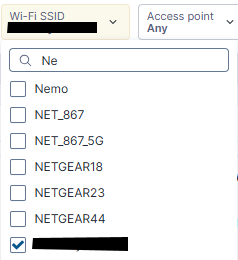
1. Start by selecting your corporate Wi-Fi SSID.
2. Scroll down to the **Wi-Fi access points with issues** section. If any access points are listed with poor Wi-Fi signal strength and/or noise levels, in addition to a significant number of devices, then this equipment should be investigated further.
3\. Points to consider:
* The physical access point may simply need to be restarted.
* A high number of devices connected to one device, with poor reception, may indicate that another access point in the office is in an error state or switched off.
* The access point may need to be relocated, or an additional access point may need to be provided, depending on the physical layout of the office environment.
### Identifying MS Teams binaries with the worst connections
Using dashboard filters and the multi-function widget, you can easily identify versions of popular applications that could be causing problems for your employees.
From the **Network diagnostics** tab in the [dashboard](https://docs.nexthink.com/platform/user-guide/live-dashboards):
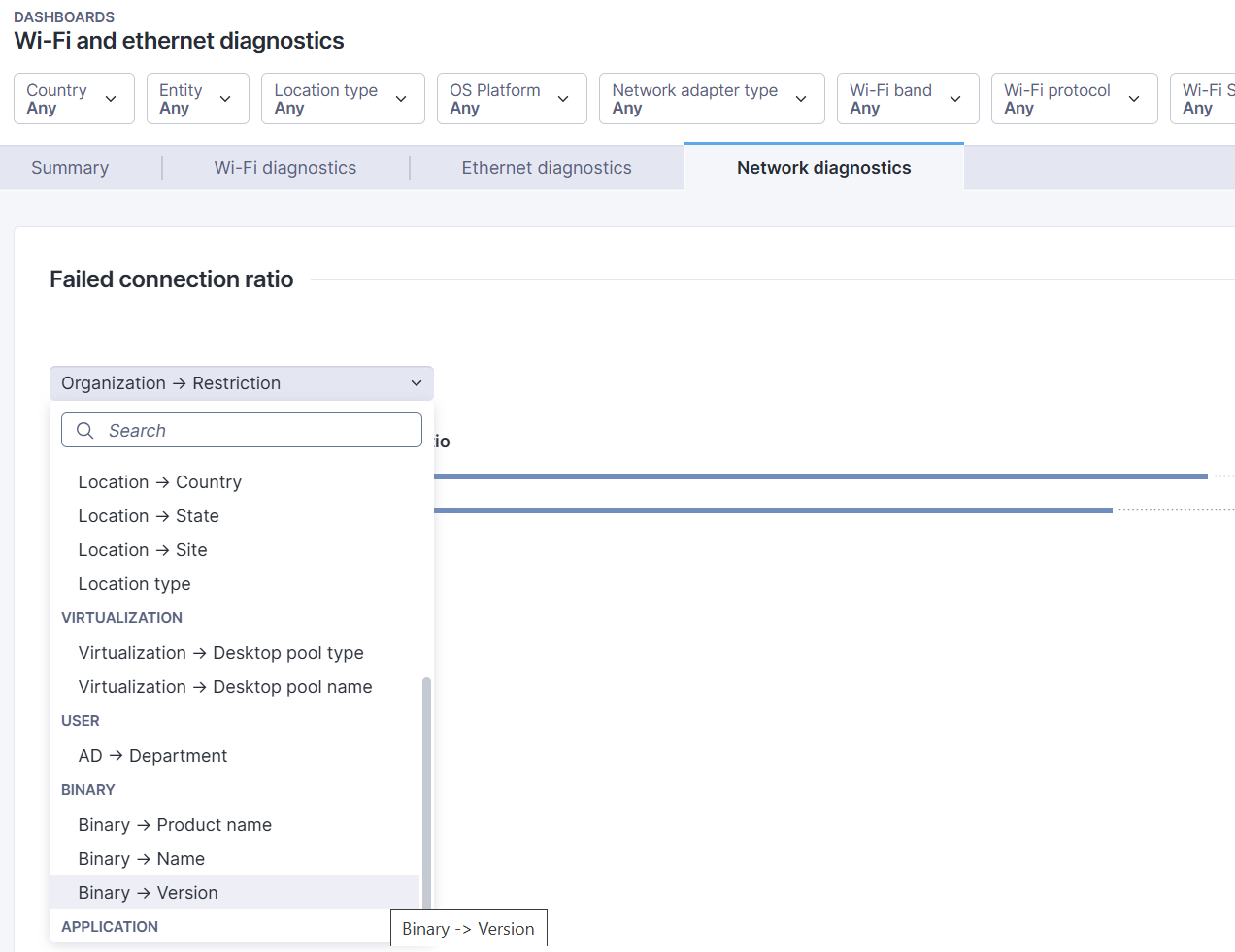
1. Start by selecting the application that you would like to analyze using the **Binary product name** filter.
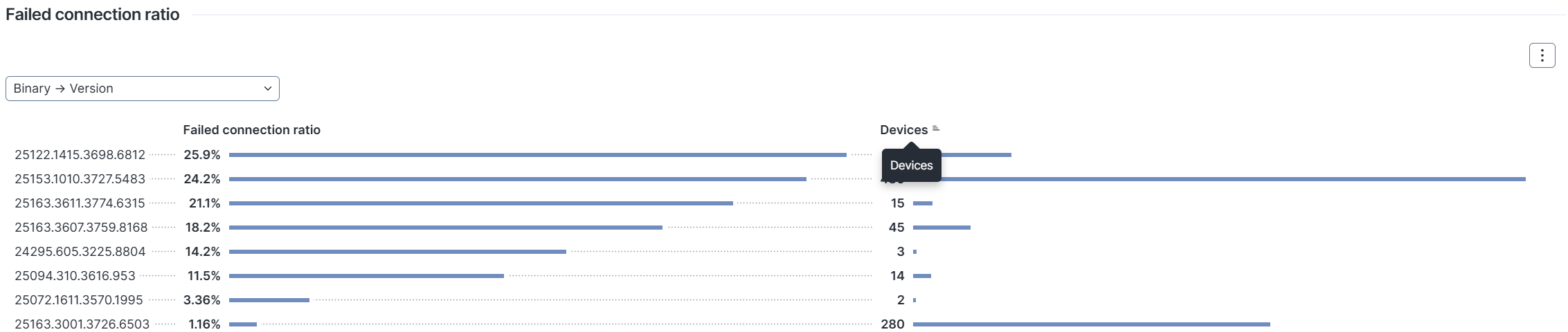
2. The bar chart showing the **Failed connection** ratio can be used to show the worst-performing versions of your chosen application.
3. Within the widget, use the drop-down menu to select **Binary version**.
3. By default, the chart is sorted by **Failed connection** ratio in descending order. If required, you can sort by the highest number of devices affected by clicking on the Devices header.
***
RELATED TOPICS
* [Wi-Fi and Ethernet diagnostics](/platform/library-packs/network-and-connectivity/wi-fi-diagnostics.md)
* [Configuration guide: Wi-Fi and Ethernet diagnostics](/platform/library-packs/network-and-connectivity/wi-fi-diagnostics/configuration-guide-wi-fi-and-ethernet-diagnostics.md)
---
# Agent Instructions
This documentation is published with GitBook. GitBook is the documentation platform designed so that both humans and AI agents can read, navigate, and reason over technical content effectively. Learn more at gitbook.com.
## Querying This Documentation
If you need additional information that is not directly available in this page, you can query the documentation dynamically by asking a question.
Perform an HTTP GET request on the current page URL with the `ask` query parameter, and the optional `goal` query parameter:
```
GET https://docs.nexthink.com/platform/library-packs/network-and-connectivity/wi-fi-diagnostics/usage-guide-wi-fi-and-ethernet-diagnostics.md?ask=&goal=
```
`ask` is the immediate question: it should be specific, self-contained, and written in natural language.
`goal` is optional and describes the broader end goal you are ultimately trying to accomplish on behalf of the user. GitBook uses it to tailor the answer towards what is most useful for that goal.
The response will contain a direct answer to the question and relevant excerpts and sources from the documentation.
Use this mechanism when the answer is not explicitly present in the current page, you need clarification or additional context, or you want to retrieve related documentation sections.