> For the complete documentation index, see [llms.txt](https://docs.nexthink.com/platform/llms.txt). Markdown versions of documentation pages are available by appending `.md` to page URLs; this page is available as [Markdown](https://docs.nexthink.com/platform/user-guide/digital-experience/getting-started-with-digital-experience.md).
# Getting started with Digital Experience
{% hint style="info" %}
All Nexthink users with the Experience Central expansion product can monitor the DEX score in the enabled Digital Experience module. If you do not have an Experience Central license, you can still configure the DEX score and monitor it using the Live Dashboards module. Contact your Nexthink representative for more information about the Experience Central expansion product.
{% endhint %}
The Digital Experience module is a strategic asset for IT leaders, offering a high-level overview of your organization’s Digital Employee Experience (DEX) score, its distribution across various employee segments and its evolution. This strategic perspective enables IT executives to understand how interactions with IT solutions and services impact employee experience over time, guiding them in shaping IT strategies and investments.
The Digital Experience module is divided into [Overview](#gettingstartedwithdigitalexperience-digitalexperiencepage) and [Benchmark](#gettingstartedwithdigitalexperience-accessingthedigitalexperiencemodule) tabs which bring you to dedicated pages.
## Accessing the Digital Experience module
Select the **Digital Experience** module from the main menu.
## Overview
The **Overview** page of the Digital Experience module comprises:
* **Digital Experience Scores**: View a summary of Technology and Sentiment scores, trends over time, impacted employees and time lost per week.
* **Technology:** See the breakdown of the score in technology gauges and metrics to quickly assess the number of employees affected by issues at the endpoint, application or collaboration nodes. Drill down on issues by clicking on nodes to open them directly in the Applications and Live Dashboards modules.
* **Sentiment**: View employee sentiment from the selected DEX score campaign.
* **Technical**: Sort Technology and Sentiment scores by operating system, versions of the operating system, device type, manufacturer and model.
* **Working environment**: Sort the DEX score by country, state and department.
{% hint style="info" %}
If you have not configured sentiment campaigns for the DEX score, the system only takes into account the Technology score when computing the DEX score. If you have enabled the Sentiment score, the DEX score comprises both the Technology and Sentiment scores.
{% endhint %}
Refer to the [Using the Overview dashboard](/platform/user-guide/digital-experience/using-the-overview-dashboard.md) documentation for more information.
## Benchmark
The Benchmark page of the Digital Experience module comprises:
* **DEX score section:** View the distribution of the DEX score for the selected industry by grouping together organizations with similar DEX scores.
* **Metrics section:** View a list of key benchmarks and all benchmarked metrics used to compute the DEX score.
Refer to the [Using the Benchmark dashboard](/platform/user-guide/digital-experience/using-the-benchmark-dashboard.md) documentation for more information.
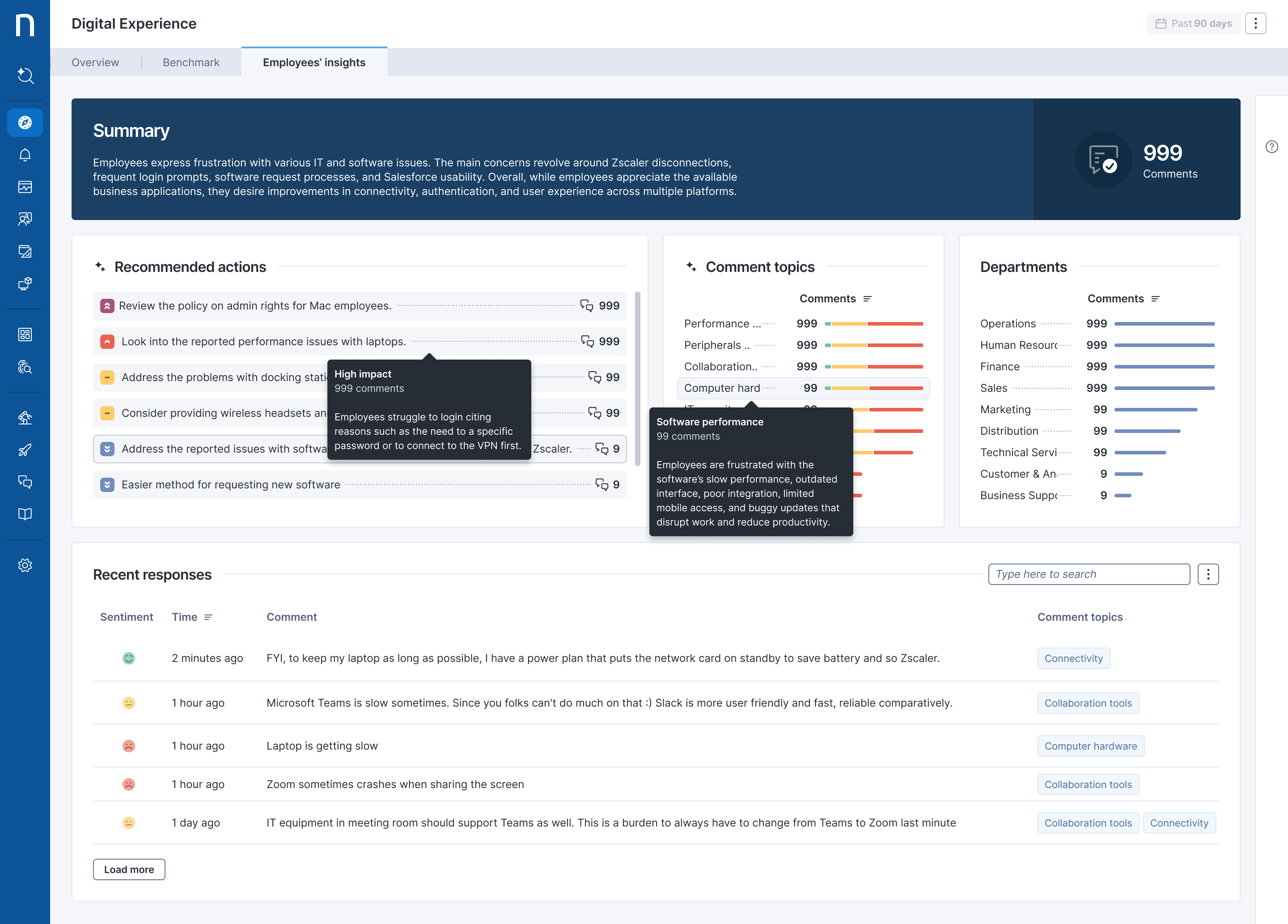
## **Employee insights**
{% hint style="warning" %}
This dashboard is only visible to customers who have configured their sentiment campaign in the system. Refer to the [Digital Experience Score Management](https://docs.nexthink.com/platform/user-guide/administration/content-management/digital-experience-score-management#digitalexperiencescoremanagement-configuringthesentimenttab) documentation for more information.
{% endhint %}
The **Employee insights** page in the **Digital Experience** module includes the following sections:
* **Summary:** Highlights major trends and themes in employee feedback
* **Recommended actions:** Provides a list of suggested actions based on the most impactful issues identified in employee feedback
* **Comment topics:** Displays a visual grouping of frequently mentioned themes
* **Departments:** Breaks down feedback by organizational department—e.g., Operations, Finance, Sales
* **Recent responses:** Shows the latest employee comments that contribute to the insights presented on the page
Refer to the[ Using the Employee insights dashboard](/platform/user-guide/digital-experience/using-employee-insights-dashboard.md) documentation for more information.
## Breaking down DEX data by employee groups
You can filter the **Overview** and **Benchmark** pages by your organization structure or employee groups to focus on specific departments, divisions, or teams.
{% hint style="info" %}
Depending on your current licensing model, this capability may require an additional license. Contact your Nexthink representative for more information.
{% endhint %}
Filters are interconnected. Selecting a value narrows the available values in other filters. Non-matching values remain visible but cannot be selected. A warning icon indicates mismatched selections that may limit your results.
The filter names displayed depend on your organization hierarchy. The example below shows Division > Department > Job Description > Office, but your names may differ.
Configuring and enriching user organization fields is required to filter DEX data by your organizational structure. To configure and enrich user organization fields, refer to [Device and user classification](/platform/user-guide/administration/system-configuration/data-management/environment/product-configuration.md).
## Configuring the Digital Experience Score
To access the Digital Experience Score configuration page:
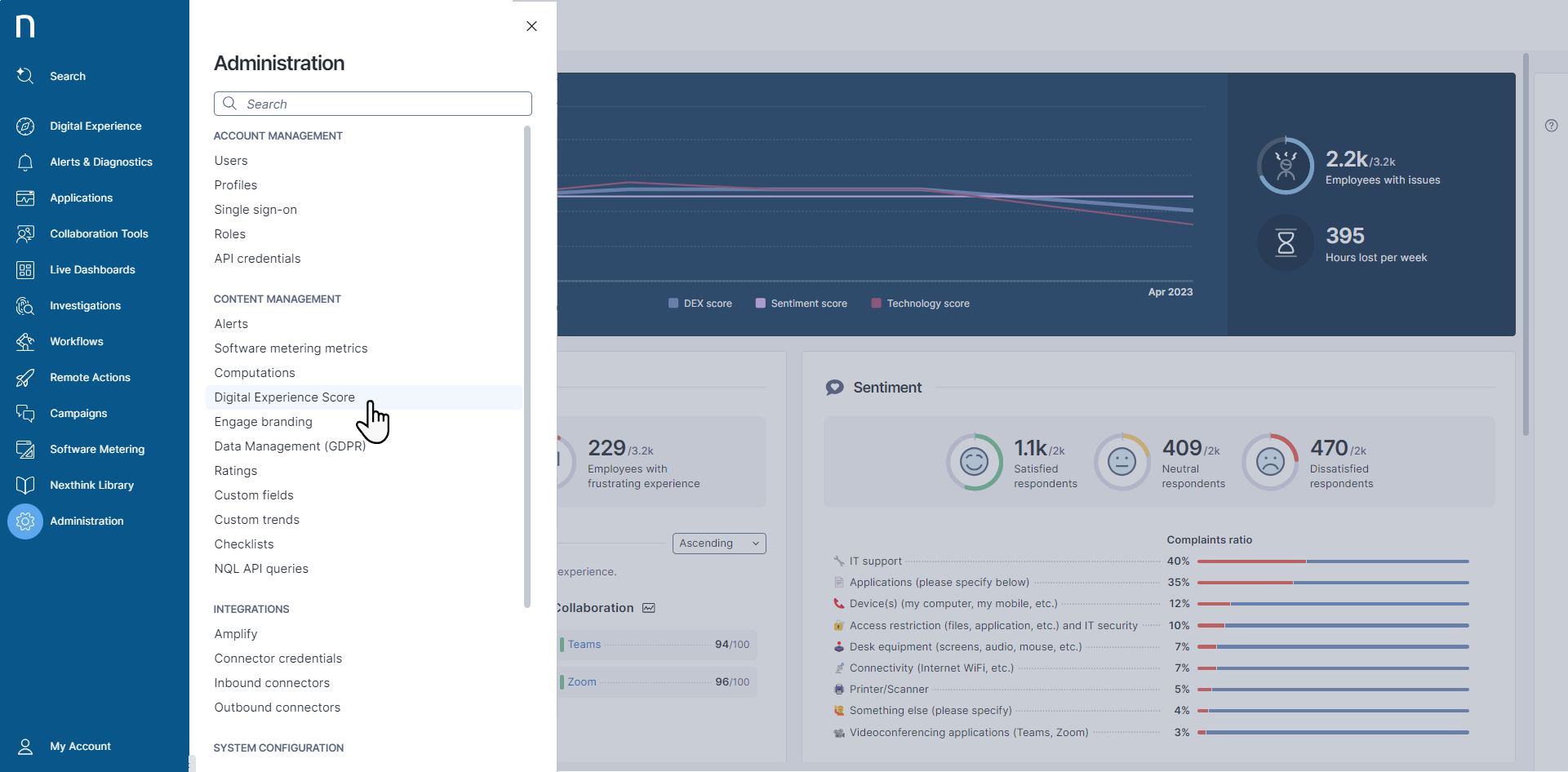
* Select **Administration** from the main menu.
* Click on **Digital Experience Score** in the Content Management section of the navigation panel.
Refer to the [Digital Experience Score Management](/platform/user-guide/administration/system-configuration/digital-experience-score-management.md) documentation for more information.
## Granting permissions for Digital Experience
{% hint style="info" %}
Refer to the [Roles](/platform/user-guide/administration/account-management/roles.md) documentation for a detailed description of **Permissions**, **View domain** options and [Data privacy](/platform/user-guide/administration/account-management/roles.md#roles-dataprivacy) granularity settings.
{% endhint %}
To enable proper permissions for Digital Experience as an administrator:
1. Select **Administration >** [Roles](/platform/user-guide/administration/account-management/roles.md) from the main navigation panel.
2. Create a **New Role** or edit an existing role by hovering over it.
3. In the **Permissions** section, scroll down to the **Digital Experience** section to enable appropriate permissions for the role.
### View domain impact on Digital Experience permissions
The table below shows what users with full and limited [View domain](/platform/user-guide/administration/account-management/roles.md#roles-viewdomain) access can do, assuming the necessary permissions are enabled.
| Permission | Full access | Limited access |
| --------------------------------- | -------------------------------------------------------------------------------------------------------------------------------------------------------------------------------------------------------------------------------------- | -------------- |
| Manage Digital Experience Score | | |
| View Digital Experience dashboard | | |
***
RELATED TOPICS
* [Using Digital Experience](/platform/user-guide/digital-experience/using-the-overview-dashboard.md)
* [DEX score](/platform/user-guide/dex-score.md)
* [Digital Experience Score Management](/platform/user-guide/administration/system-configuration/digital-experience-score-management.md)
---
# Agent Instructions
This documentation is published with GitBook. GitBook is the documentation platform designed so that both humans and AI agents can read, navigate, and reason over technical content effectively. Learn more at gitbook.com.
## Querying This Documentation
If you need additional information that is not directly available in this page, you can query the documentation by asking a question.
Perform an HTTP GET request on the following URL with the `ask` and `goal` query parameters:
```
GET https://docs.nexthink.com/platform/user-guide/digital-experience/getting-started-with-digital-experience.md?ask=&goal=
```
`ask` is the immediate question: it should be specific, self-contained, and written in natural language.
`goal` is what the user is ultimately trying to achieve, the reason they need the answer. Sharing it helps GitBook give you a better, more relevant answer. A goal is most helpful when it describes the outcome the user wants rather than restating the question. For example, with `ask=how do I create an API token`, a goal like `automate deployments from our CI pipeline` lets GitBook tailor the answer to that use case.
The response will contain a direct answer to the question and relevant excerpts and sources from the documentation.
Use this mechanism when the answer is not explicitly present in the current page, you need clarification or additional context, or you want to retrieve related documentation sections.



 | |
| View Digital Experience dashboard |