> For the complete documentation index, see [llms.txt](https://docs.nexthink.com/platform/llms.txt). Markdown versions of documentation pages are available by appending `.md` to page URLs; this page is available as [Markdown](https://docs.nexthink.com/platform/user-guide/adopt/guide-content-development-from-in-app-adopt-editor/developing-media-guides.md).
# Developing Media guides
Media Guides allow you to embed existing media or articles within your SaaS applications. You can access Media within the Nexthink Guides Context help panel depending on contextual rules and conditions.
The image below exemplifies how employees view media-type guides with a smart-page display referencing external content from the web application.
## Using Guides Editor for Media content development
After [accessing Guides Editor](#accessing-adopt-editor-for-tooltips) for Media:
1. **Add Media** or use the **+** icon in the Guides Editor.
2. Open the Media **properties** to access the **Media** property tab. Here, you can add text and content to your Guide.
## Adding text and content to Media
From the[ Guides Editor left-side panel,](#understanding-adopt-editor-for-media) access the **Properties** of a Media Guide to add the content visible and/or audible to employees using the Guide:
* **Define a name** for your Media, which will be visible in **Context help**.
* Write and format the text using the **Media content** editor.
* This is not applicable to **Links**.
* Select a source for your Media:
* **Select** a file from the [Asset library](/platform/user-guide/adopt/guide-creation-and-management-from-nexthink-applications/managing-adoption-assets-with-the-asset-library.md).
* **Input a URL** for the Media you want to display.
* Define the **Context help icon** accompanying the Media: **Link**, **PDF** or **Video**.
{% hint style="info" %}
You can only use Media that can be embedded within an iframe.
{% endhint %}
* Define the **Overlay** type:
* **Panel** displays the content on a left-side panel. This overlay is best suited for embedding PDF and video content within the same page.
* **Smart page** opens a window at the center of the page with the embedded content inside, with logic similar to a Walkthrough Step. Once users have viewed the content, they can select **Done** instead of closing the window.
* **Notice** displays the content in a broad box at the bottom of the page, similar to a notification.
* **Sidebar** is visually similar to **Panel**, but follows the same rules as **Smart page**.
* **Link** does not display the content. It opens a new tab and redirects the user to the configured URL.
## Adding SharePoint content to Media
{% hint style="warning" %}
Before you add SharePoint content to Media, ensure you have a valid Microsoft 365 authentication token, as Nexthink Guides does not handle authentication otherwise and displays an error message.
{% endhint %}
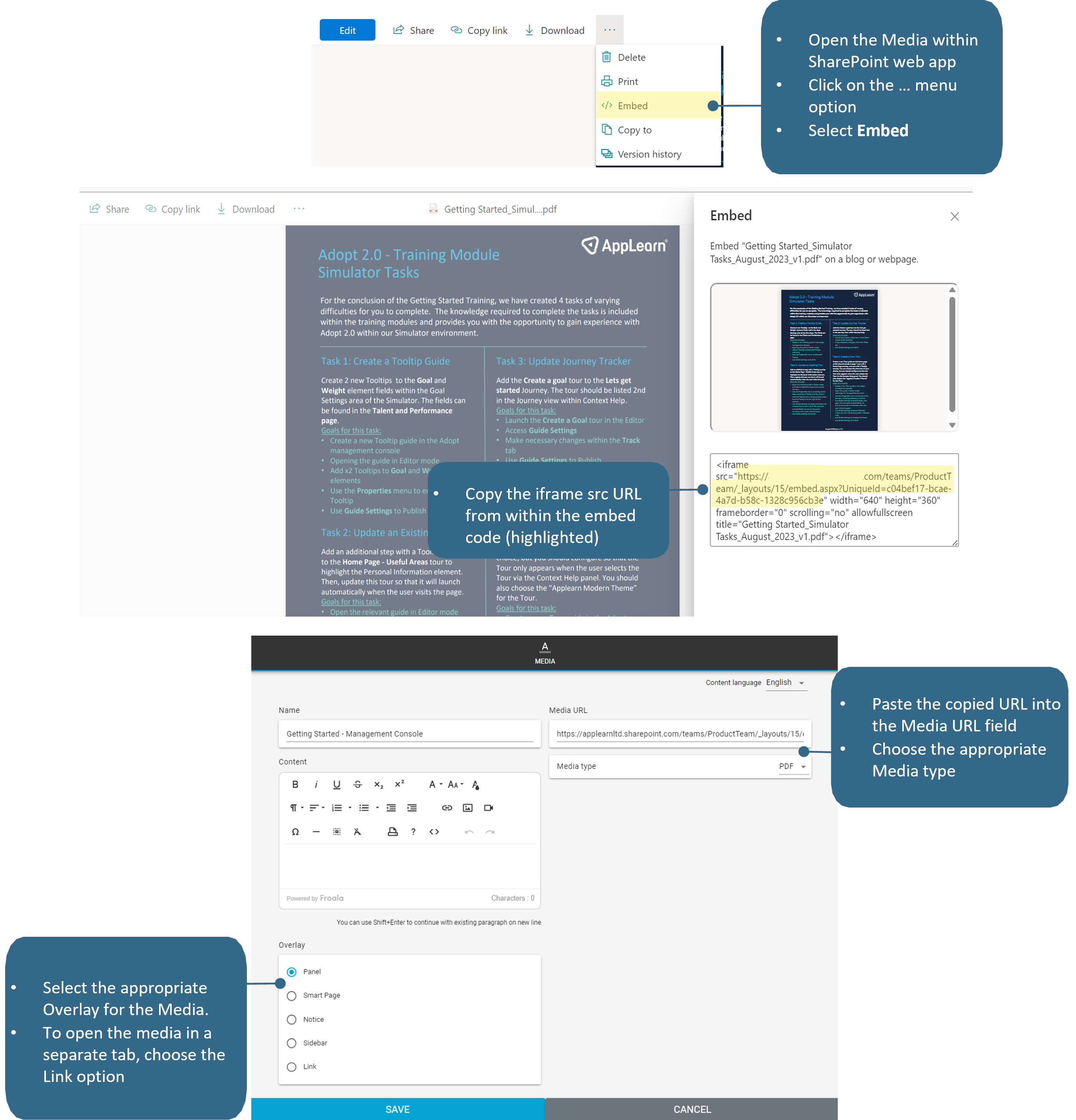
You can embed content from your existing content libraries through the Editor by following these steps:
1. Open your content in the SharePoint web application.
2. From the hamburger menu, select **Embed**.
3. Copy the `iframe src` URL from the embed code.
4. Paste the copied URL into the Media URL field in the Editor.
1. Remember to select the appropriate Media type.
---
# Agent Instructions
This documentation is published with GitBook. GitBook is the documentation platform designed so that both humans and AI agents can read, navigate, and reason over technical content effectively. Learn more at gitbook.com.
## Querying This Documentation
If you need additional information that is not directly available in this page, you can query the documentation by asking a question.
Perform an HTTP GET request on the following URL with the `ask` and `goal` query parameters:
```
GET https://docs.nexthink.com/platform/user-guide/adopt/guide-content-development-from-in-app-adopt-editor/developing-media-guides.md?ask=&goal=
```
`ask` is the immediate question: it should be specific, self-contained, and written in natural language.
`goal` is what the user is ultimately trying to achieve, the reason they need the answer. Sharing it helps GitBook give you a better, more relevant answer. A goal is most helpful when it describes the outcome the user wants rather than restating the question. For example, with `ask=how do I create an API token`, a goal like `automate deployments from our CI pipeline` lets GitBook tailor the answer to that use case.
The response will contain a direct answer to the question and relevant excerpts and sources from the documentation.
Use this mechanism when the answer is not explicitly present in the current page, you need clarification or additional context, or you want to retrieve related documentation sections.