> For the complete documentation index, see [llms.txt](https://docs.nexthink.com/llms.txt). Markdown versions of documentation pages are available by appending `.md` to page URLs; this page is available as [Markdown](https://docs.nexthink.com/library-packs/software-asset-management/workflow_-microsoft-365-e5-license-optimization/usage-guide_-microsoft-365-e5-license-optimization.md).
# Usage guide: Microsoft 365 E5 license optimization
## Overview
Managing Microsoft 365 licenses efficiently is crucial for cost control. Organizations often struggle with assigning the right licenses to the right users, leading to unnecessary expenses. To address this, an automated workflow within Entra ID streamlines the process. By detecting E5 license holders, seeking reclamation consent, and transitioning to E3 licenses, organizations can save time and reduce costs. Leveraging Power BI Pro consumption data enhances accuracy in targeting users for license adjustments.
Ensure your library pack is properly configured by following the steps highlighted in its configuration guide:
[Configuration guide: Microsoft 365 E5 license optimization](/library-packs/software-asset-management/workflow_-microsoft-365-e5-license-optimization/configuration-guide_-microsoft-365-e5-license-optimization.md)
## Workflow Structure
This workflow is primarily designed to run automatically using a scheduled trigger. However, it can also be manually triggered for ad hoc usage. The first step of the workflow is to check if a user belongs to a security group associated with a specific software license. This allows the workflow to be run on all users who are not using the software.
This section describes the key steps in this workflow:
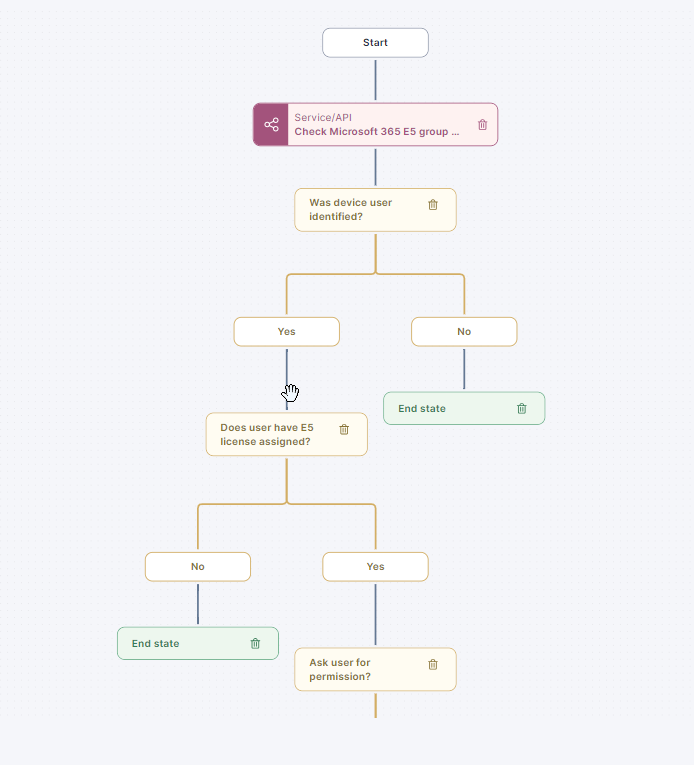
* Check the device user’s group affiliation. Should the user not belong to the group outlined in the workflow parameter “**MS365 E5 authorization group**”, halt the process. Conversely, if they are a member of the group, launch a campaign to inquire whether they will require the Microsoft Power BI application in the upcoming period.
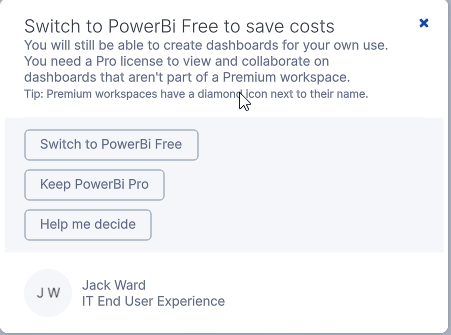
* If the “**Ask for permission?**” workflow parameter is enabled, the user will be presented with the following campaign”
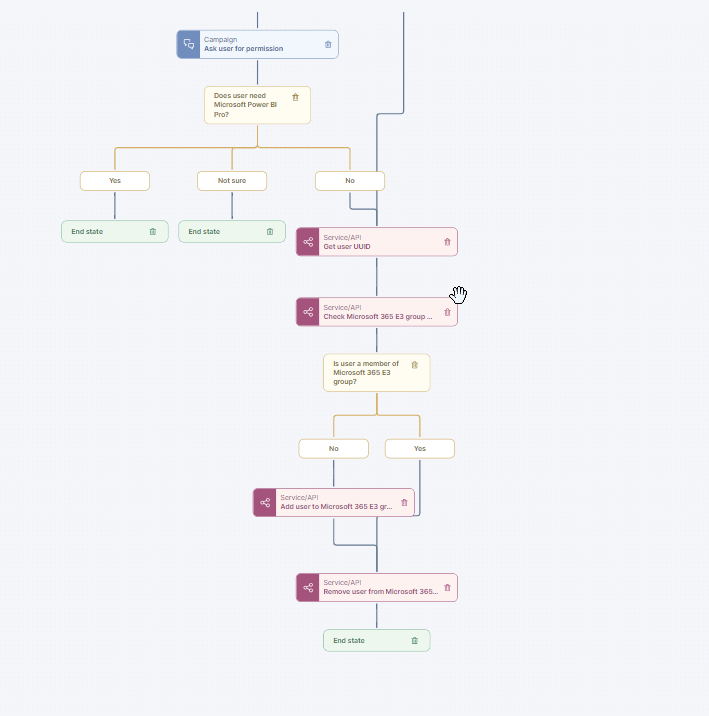
* The workflow advances to the stage where it retrieves the user’s UUID, a vital step for the following verification of the user’s group membership according to the “**MS365 E3 authorization group**” workflow parameter. If the user is not a member of the E3 group, they are included in it, and ultimately, they are removed from the group defined by the **“MS365 E5 authorization group”** workflow parameter.
***
RELATED TOPICS
* [Manage Workflows](https://nexthink.gitbook.io/opd/user-guide/workflows/managing-workflows)
* [Manage Campaigns](https://nexthink.gitbook.io/opd/user-guide/campaigns/managing-campaigns)
---
# Agent Instructions
This documentation is published with GitBook. GitBook is the documentation platform designed so that both humans and AI agents can read, navigate, and reason over technical content effectively. Learn more at gitbook.com.
## Querying This Documentation
If you need additional information that is not directly available in this page, you can query the documentation by asking a question.
Perform an HTTP GET request on the following URL with the `ask` and `goal` query parameters:
```
GET https://docs.nexthink.com/library-packs/software-asset-management/workflow_-microsoft-365-e5-license-optimization/usage-guide_-microsoft-365-e5-license-optimization.md?ask=&goal=
```
`ask` is the immediate question: it should be specific, self-contained, and written in natural language.
`goal` is what the user is ultimately trying to achieve, the reason they need the answer. Sharing it helps GitBook give you a better, more relevant answer. A goal is most helpful when it describes the outcome the user wants rather than restating the question. For example, with `ask=how do I create an API token`, a goal like `automate deployments from our CI pipeline` lets GitBook tailor the answer to that use case.
The response will contain a direct answer to the question and relevant excerpts and sources from the documentation.
Use this mechanism when the answer is not explicitly present in the current page, you need clarification or additional context, or you want to retrieve related documentation sections.