> For the complete documentation index, see [llms.txt](https://docs.nexthink.com/llms.txt). Markdown versions of documentation pages are available by appending `.md` to page URLs; this page is available as [Markdown](https://docs.nexthink.com/user-guide/alerts-and-diagnostics/getting-started-with-diagnostics/system-crashes.md).
# System crashes
Assess and troubleshoot issues related to system crashes on macOS and Windows devices.
## Accessing System crashes
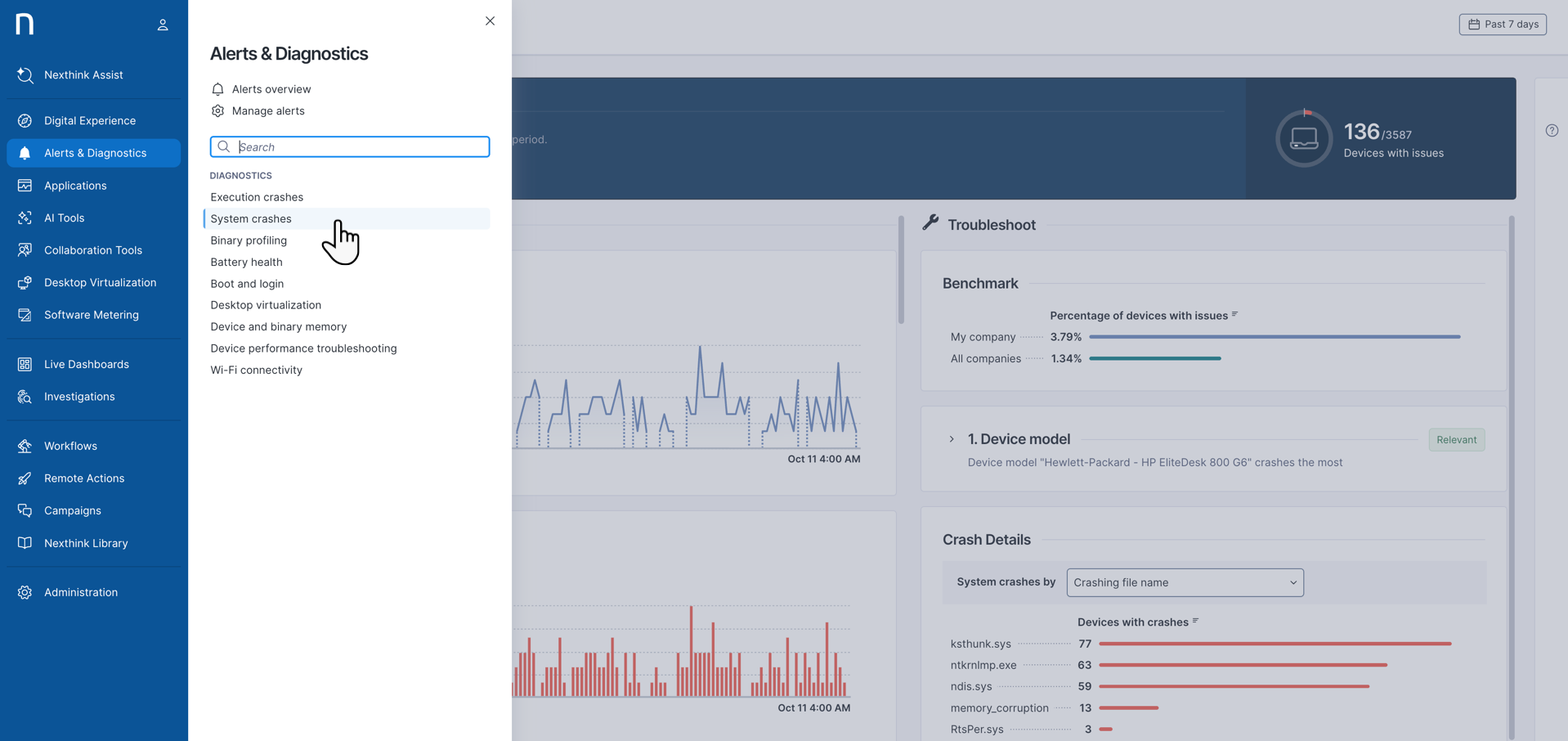
To access the **System crashes** dashboard, open **Alerts and Diagnostics** → **Alerts and Diagnostics** from the navigation menu.
{% hint style="info" %}
The page shows detailed information about system crashes for impacted devices over the **Past 7 days**.
A device is impacted if at least one system crash occurred during the selected time period.
{% endhint %}
## Interpreting System crashes
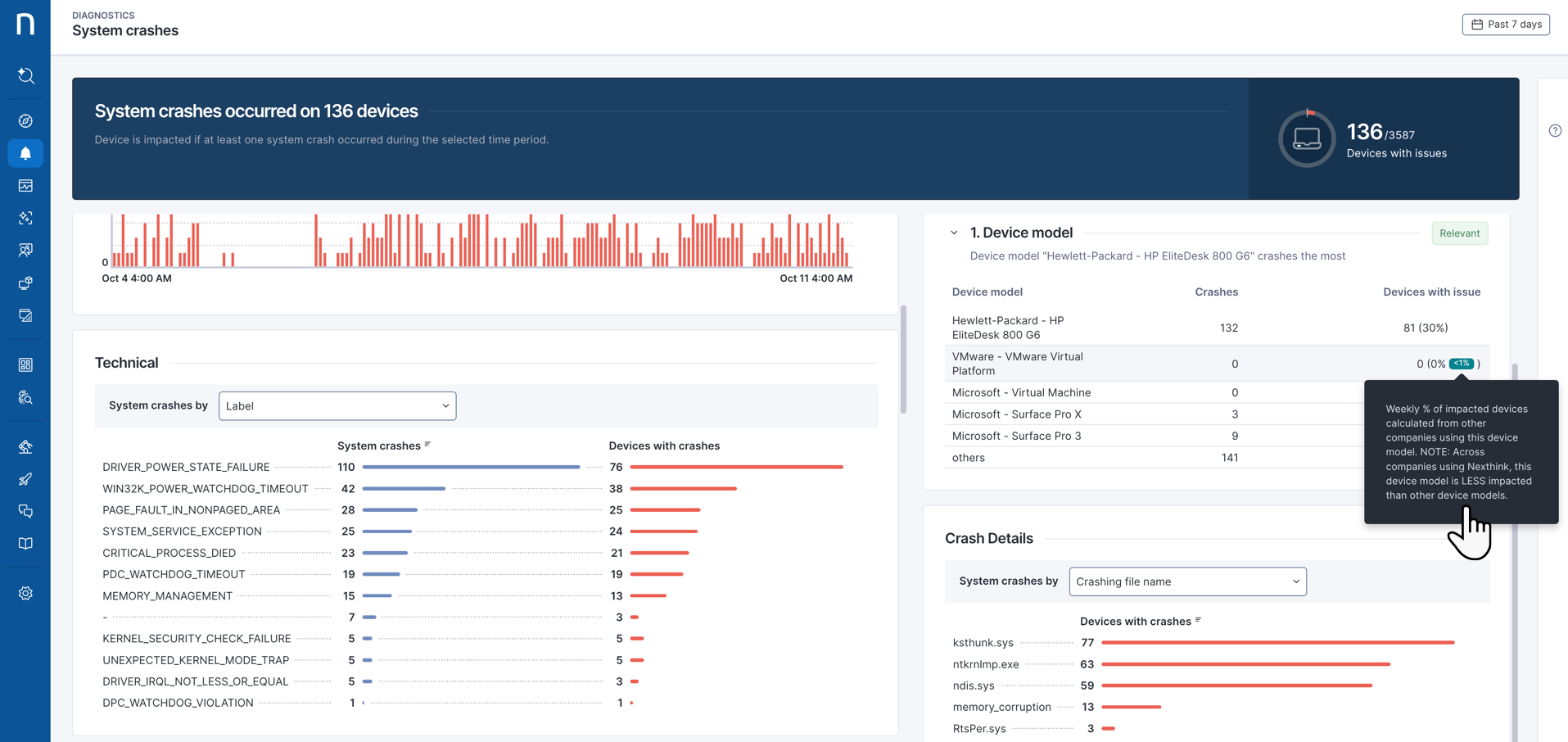
The **System crashes** dashboard contains the following widgets grouped into the sections:
* **Assess issue**
* **Troubleshoot**
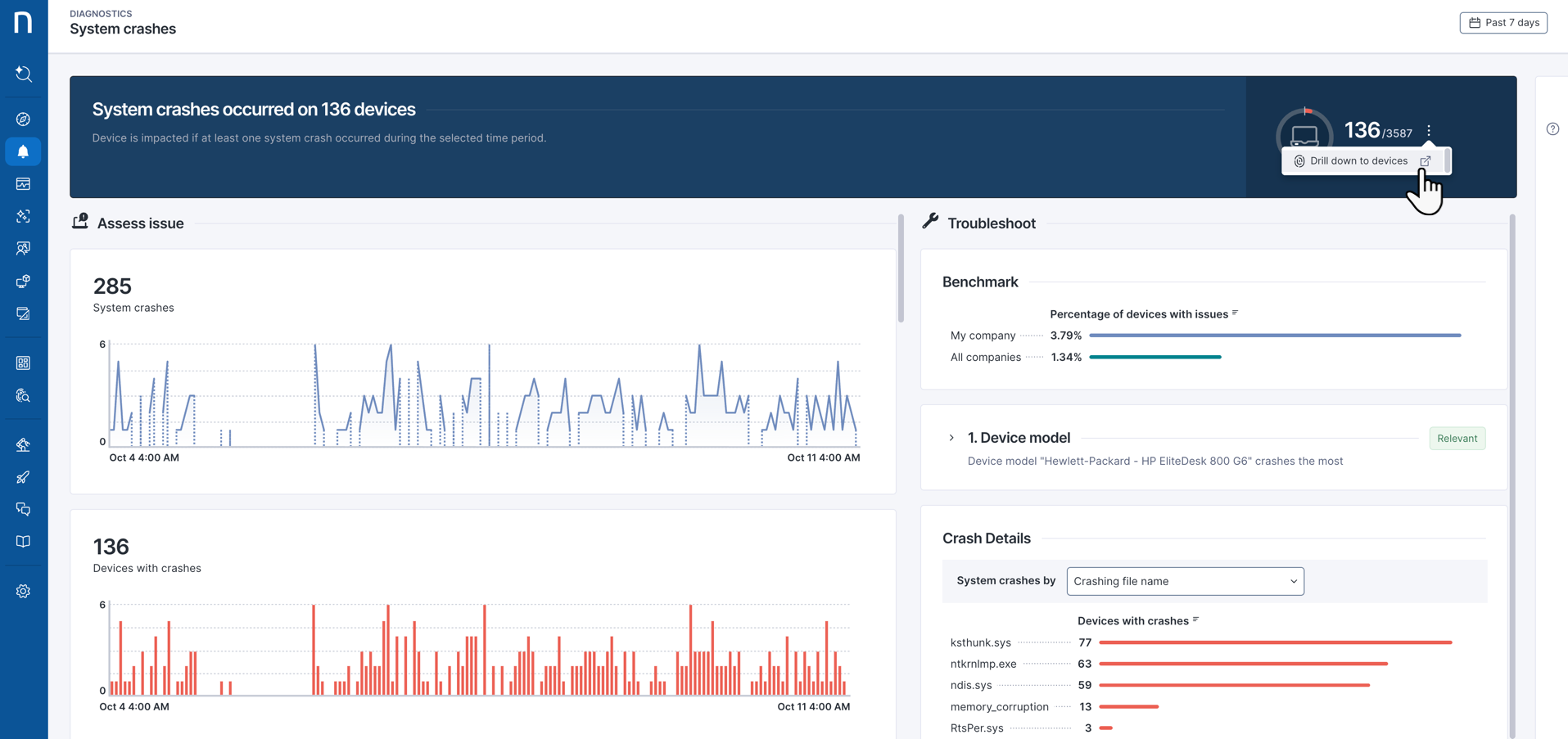
The top banner displays the number of devices for which system crashes have occurred:
Hover over the **Devices with issue** gauge on the right side of the banner to reveal the action menu, and **Drill down to devices—**the Investigations page provides more information about impacted devices.
## Assess issue
From the **Assess issue** section, understand the context and scope of system crashes:
* **System crashes**: View system crashes over a given time period on a line chart. Hover over the line to reveal tooltips with more information.
* **Devices with crashes**: View devices over a given time period on a bar chart. Click on individual bars to reveal tooltips with more information.
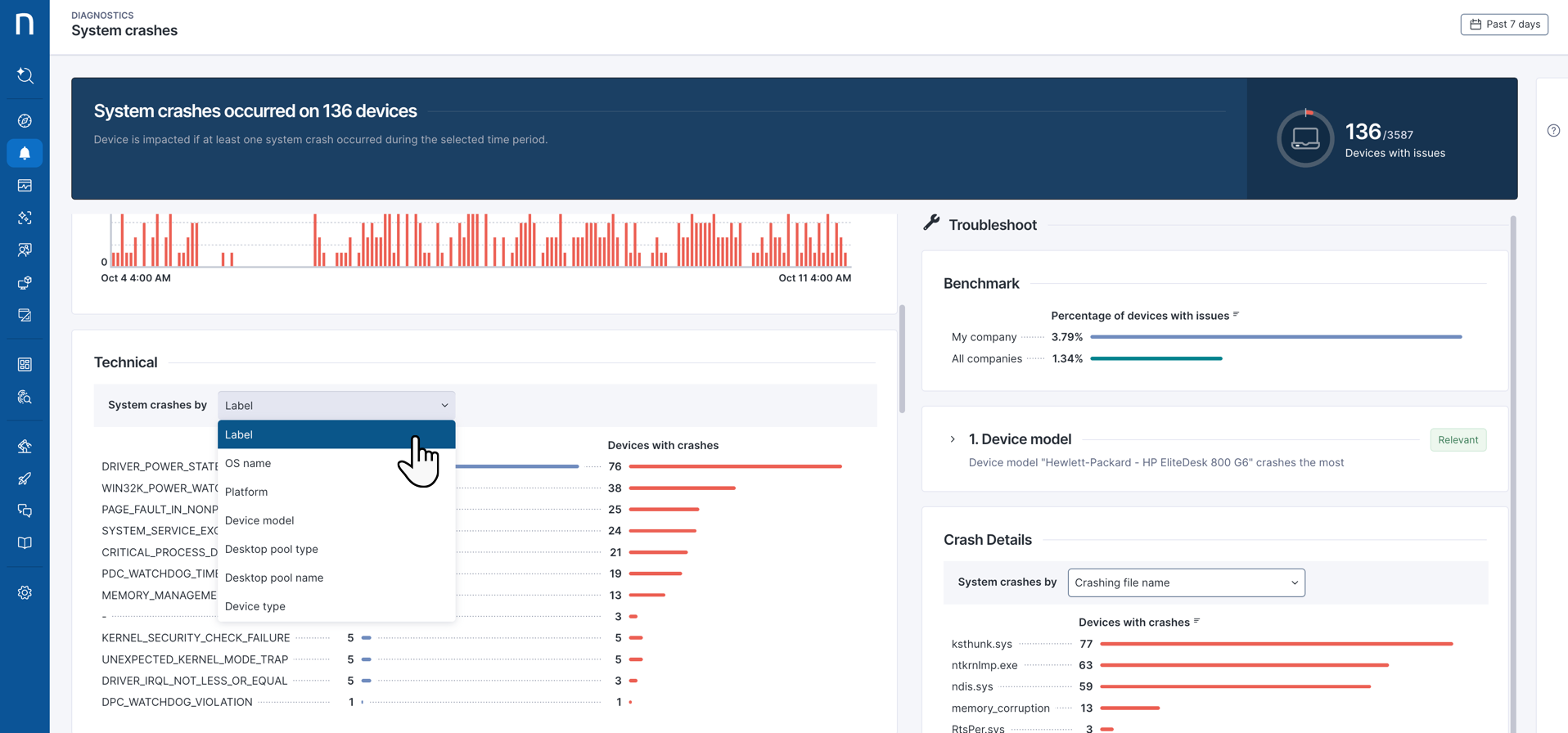
* **Technical**: Filter results by technical criteria such as **Operating System**, **Platform**, **Hardware model**, **Virtualization type**, and **Error Code**.
* **Location**: Filter results by geolocation hierarchy. This section is visible only if the Geolocation feature is enabled. You can configure it on the [Product configuration](/user-guide/administration/system-configuration/data-management/environment/product-configuration.md) page of the Administration module.
* **Organization**: Filter results by entity and organizational hierarchy.
## Troubleshoot
From the **Troubleshoot** section in the **System crashes** dashboard, you can:
* **Benchmark** system crashes across organizations.
* Identify the **Device model** with the most issues.
* Break down **Crash Details** by drivers and files.
### Benchmark
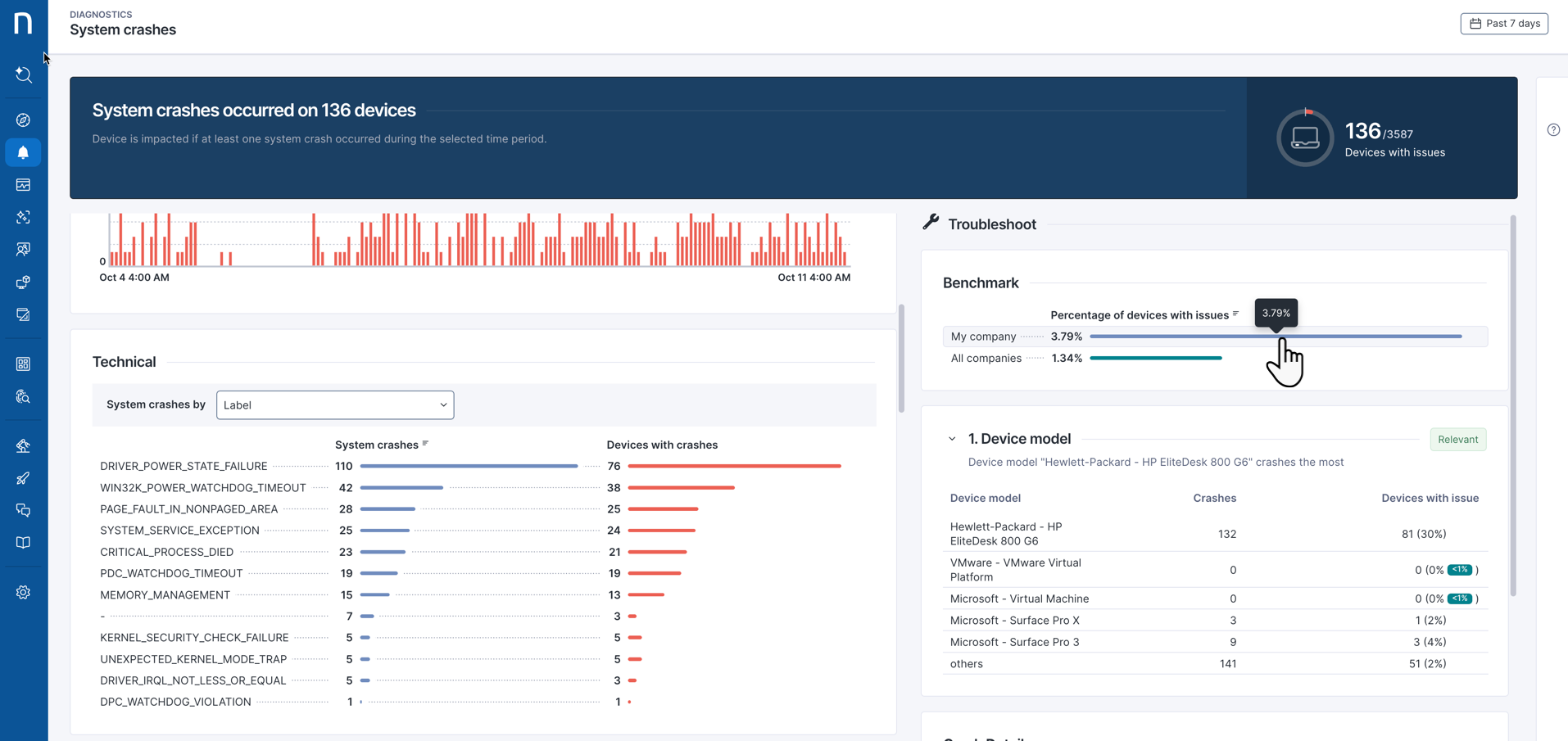
Compare the weekly percentage of devices with system crashes in your organization against other companies. Benchmark data is collected from all Nexthink cloud customers in all regions.
### Device model
Identify the **Device model** with the most issues relevant to system crashes.
* **Device model**: View information about the device model.
* **Crashes**: View the total number of crashes for a given property value.
* **Devices with issue**: View the total number of devices that had a crash.
The percentage is calculated with respect to the total number of devices with the given property value. Hover over the percentage with the teal background to reveal a tooltip with more information.
***
RELATED LINKS
* [Getting started with Diagnostics](/user-guide/alerts-and-diagnostics/getting-started-with-diagnostics.md)
* [Product configuration](/user-guide/administration/system-configuration/data-management/environment/product-configuration.md)
---
# Agent Instructions
This documentation is published with GitBook. GitBook is the documentation platform designed so that both humans and AI agents can read, navigate, and reason over technical content effectively. Learn more at gitbook.com.
## Querying This Documentation
If you need additional information that is not directly available in this page, you can query the documentation by asking a question.
Perform an HTTP GET request on the following URL with the `ask` and `goal` query parameters:
```
GET https://docs.nexthink.com/user-guide/alerts-and-diagnostics/getting-started-with-diagnostics/system-crashes.md?ask=&goal=
```
`ask` is the immediate question: it should be specific, self-contained, and written in natural language.
`goal` is what the user is ultimately trying to achieve, the reason they need the answer. Sharing it helps GitBook give you a better, more relevant answer. A goal is most helpful when it describes the outcome the user wants rather than restating the question. For example, with `ask=how do I create an API token`, a goal like `automate deployments from our CI pipeline` lets GitBook tailor the answer to that use case.
The response will contain a direct answer to the question and relevant excerpts and sources from the documentation.
Use this mechanism when the answer is not explicitly present in the current page, you need clarification or additional context, or you want to retrieve related documentation sections.