> For the complete documentation index, see [llms.txt](https://docs.nexthink.com/platform/llms.txt). Markdown versions of documentation pages are available by appending `.md` to page URLs; this page is available as [Markdown](https://docs.nexthink.com/platform/references/references-classic/search-and-information-display-classic/widget-compute-state-in-charts-classic.md).
# Widget compute state in charts (classic)
### Overview
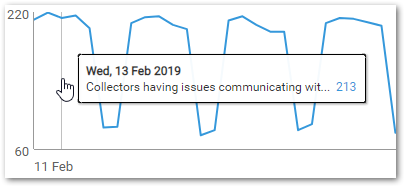
For line chart widgets, the state of the computation of the associated metric for a particular date is directly available from the chart. When the metric is successfully computed, Portal displays a solid line in the line chart.
When the computation of the metric is consistently successful for several days, the solid line joins the points that represent the value of the metric along the whole selected period. Hovering the cursor over the chart displays the value of the computation on the selected date:
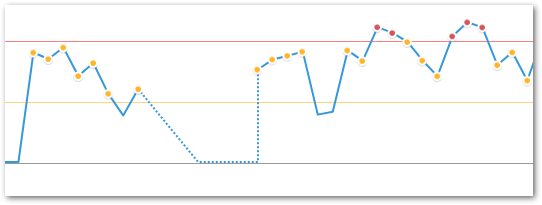
If a metric defines threshold values, they can be made visible in the line chart by ticking the option **Thresholds** when configuring the widget. The lower threshold is depicted as a horizontal orange line and the higher threshold as a horizontal red line. Likewise, value points in the chart are highlighted in orange when they exceed the first threshold value or in red when they exceed the second threshold value:
However, Portal is not always able to compute the metric of a widget on a particular date. When this happens, the chart of the widget replaces the solid blue line by a dashed line or by empty space to indicate that the computation could not be carried out. Hovering over a non-computed area of a chart with the cursor displays a message that helps you identify the cause for the lack of data.
We list below the reasons why there might be a lack of data in the chart of a widget and we illustrate them with example figures from Portal. We finally discuss the
### Line charts
#### First computation of the widget
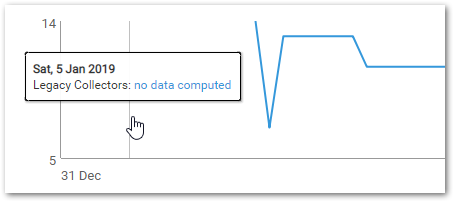
Before the first computation of a widget, there is no data available for it. The chart will not display any line before the first computation of the widget.
If you hover the cursor over the empty area, the chart displays the date, the name of the metric and the message **no data computed**:
#### Not computed
A widget can miss some days of computation because either Portal or the Engine was stopped or because the connection between Portal and the Engine was lost for some time.
If the computation was not run on one or more days, the chart displays a dashed straight red line between the two dates where there is actually some data. Additionally, when you hover the cursor over it, the chart displays the message **no data computed**.
#### No activity
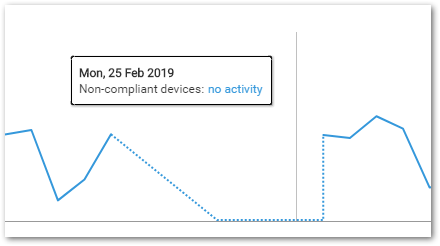
The widget was not computed because there was not data available for it. The connection with the Engine is fine in this case, but the Engine just does not provide proper data for the widget.
This occurs with both activity widgets and service widgets when the type of activity that they monitor did not take place over the requested period of time and providing a zero value does not make sense. For example, a widget that computes the average response time of an application will show no activity if the application was not executed over the specified period. Showing zero response time for the application is not a valid option in this case.
This situation can also happen with inventory and issue widgets that refer to objects grouped by a specific keyword. If you change the group by property of the widget and you do not recompute it for the past dates, the data for those dates will be lost showing no activity.
The chart displays a dashed blue line at the level of the axis and the message **no activity** when hovering with the mouse.
### Other widgets
KPI, table and bar chart widgets represent the absence of computed metric data by a dash ( **-** ) in place of the value.
### All widgets
#### One day only
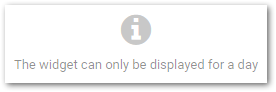
Because of an undefined aggregation strategy, the computation of some metrics does not make sense for periods longer than one day. When selecting a period longer than one day in Portal, the widgets related to these metrics show the following message:
#### Configuration issues
If a widget has a configuration error, e.g. because the associated metric has been deleted, Portal displays the following message in the middle of the dashboard area assigned to the widget:
***
RELATED REFERENCES
* [Types of widgets](/platform/references/references-classic/search-and-information-display-classic/types-of-widgets-classic.md)
* [Widget](/platform/references/references-classic/glossary-classic/widget-classic.md)
---
# Agent Instructions
This documentation is published with GitBook. GitBook is the documentation platform designed so that both humans and AI agents can read, navigate, and reason over technical content effectively. Learn more at gitbook.com.
## Querying This Documentation
If you need additional information that is not directly available in this page, you can query the documentation dynamically by asking a question.
Perform an HTTP GET request on the current page URL with the `ask` query parameter, and the optional `goal` query parameter:
```
GET https://docs.nexthink.com/platform/references/references-classic/search-and-information-display-classic/widget-compute-state-in-charts-classic.md?ask=&goal=
```
`ask` is the immediate question: it should be specific, self-contained, and written in natural language.
`goal` is optional and describes the broader end goal you are ultimately trying to accomplish on behalf of the user. GitBook uses it to tailor the answer towards what is most useful for that goal.
The response will contain a direct answer to the question and relevant excerpts and sources from the documentation.
Use this mechanism when the answer is not explicitly present in the current page, you need clarification or additional context, or you want to retrieve related documentation sections.