> For the complete documentation index, see [llms.txt](https://docs.nexthink.com/llms.txt). Markdown versions of documentation pages are available by appending `.md` to page URLs; this page is available as [Markdown](https://docs.nexthink.com/library-packs/applications/adopt-library-packs/guide-adoption/usage-guide-guide-adoption.md).
# Usage guide: Guide adoption
{% hint style="info" %}
This page outlines various ways to use the pack, including use case examples.
Administrators can refer to the [Configuration guide: Guide adoption](/library-packs/applications/adopt-library-packs/guide-adoption/configuration-guide-guide-adoption.md) to set up and customize the installed content.
{% endhint %}
The **Guide adoption** library pack enables EUC teams to:
* Track adoption metrics, including published guides, manual starts, engagement, completion rates, drop-offs, and average duration.
* Distinguish adoption trends across walkthroughs, tooltips, and media guides.
* Understand where guides are most effective within the application
* Inspect step-level engagement to pinpoint user friction
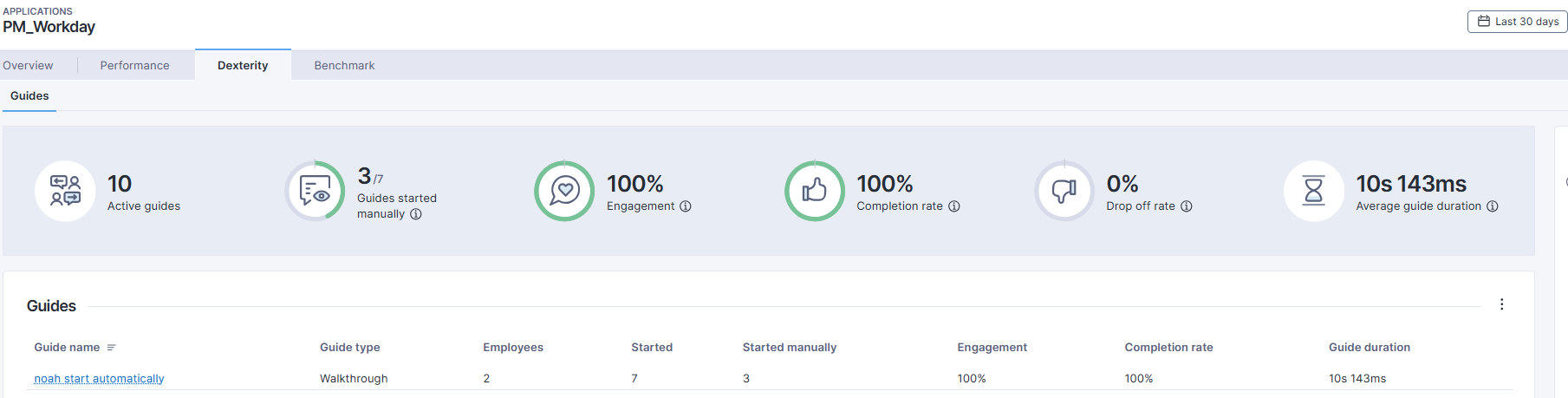
This pack includes a live dashboard designed to mirror the [Application Dexterity](https://docs.nexthink.com/platform/user-guide/applications/monitoring-applications/monitoring-web-applications/guides) experience but with enhanced granularity. Unlike static dashboards, it supports drilldowns into real-time data, offering deeper usage insights and investigation capabilities.
## Library pack uses
{% hint style="info" %}
Jump to [Use cases](#use-cases) on this page to see relevant scenario applications.
{% endhint %}
Use the library pack content for the following purposes:
### **Visibility**
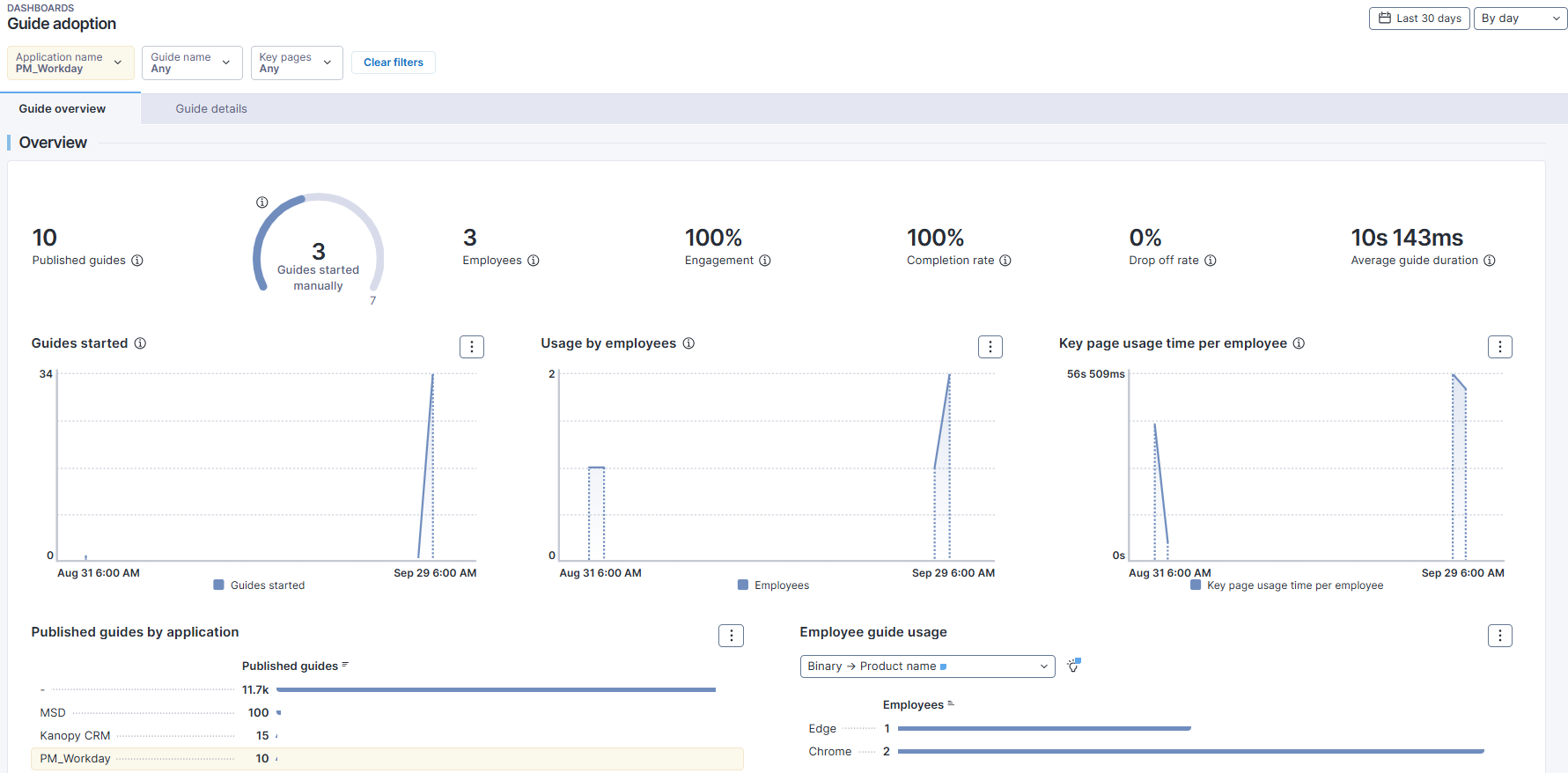
The Guide adoption [live dashboard](https://docs.nexthink.com/platform/user-guide/live-dashboards) is the core element of this pack. It mirrors the **Application Dexterity** dashboard while offering expanded insights. With familiar KPIs and a focus on page-level and step-level guide engagement, the dashboard turns basic adoption metrics into actionable insights. You can:
* Drill down into live usage data
* Spot trends across guide types
* Launch investigations from the dashboard directly
#### Navigating the dashboard
The provided Dexterity tab for your chosen application is ideal for an at-a-glance summary of guide usage and adoption.
For in-depth analysis, however, it can be more complicated to determine, for example, the actual employees who are using guides or how guide usage is changing over time.
The provided [live dashboard](https://docs.nexthink.com/platform/user-guide/live-dashboards) **Guide adoption** aims to replicate these key KPIs and to provide additional insights, such as:
* Guides started over time
* Employee usage over time
* Published guides by application
* Employee guide usage by multiple breakdowns.
## Use cases
In addition to the relevant use cases covered below, you may uncover other troubleshooting scenarios specific to your environment.
### Identifying employees who spend the most time on guides
Guides with longer durations often support complex processes that involve multiple steps. Identifying the employees who spend the most time on these guides can help you:
* Understand user challenges
* Improve clarity and flow
* Target them with **Engage** campaigns for feedback
From the **Guide overview** tab:
1. Scroll down to the "Walkthrough" breakdown:
2. By default, the bar chart is sorted by Employees. Click the "Guide duration" header to sort by the longest-running guides.
3. **Drill down** to the listed employees to determine who is engaging most with this particular guide.
### Identifying problematic steps within a guide
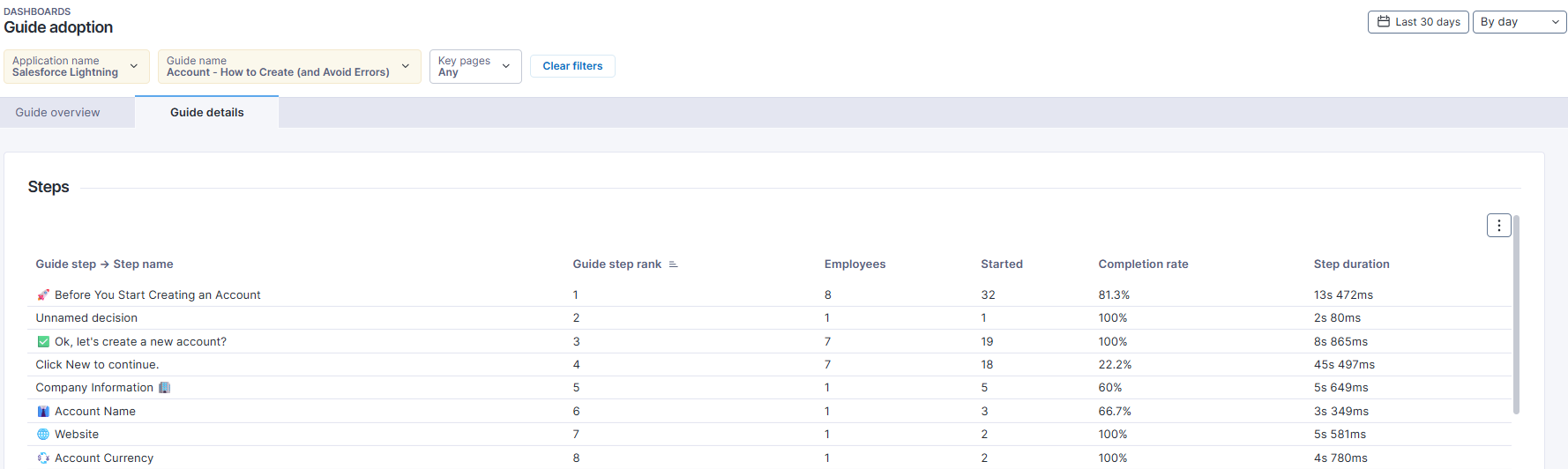
Long step durations or low step completion rates can signal friction or confusion.
To analyze step-level behavior in the Guide adoption live dashboard:
1. Select a guide from the Walkthrough breakdown or use the dashboard filter.
2. Switch to the Guide details tab to access the Steps table.
3. Identify steps with unusually long durations or low completion rates. This may indicate a complicated procedure or an error within the guide itself.
4. Optionally, contact users engaging with those steps for further investigation or feedback.
5. This analysis helps improve guide effectiveness and ensures smoother employee experiences.
## RELATED TOPICS
* [Manage live dashboards](https://nexthink.gitbook.io/opd/user-guide/live-dashboards/managing-live-dashboards)
* [Manage remote actions](https://nexthink.gitbook.io/opd/user-guide/remote-actions/managing-remote-actions)
* [Manage campaigns](https://nexthink.gitbook.io/opd/user-guide/campaigns/managing-campaigns)
* [Manage workflows](https://nexthink.gitbook.io/opd/user-guide/workflows/managing-workflows)
* [Manage custom fields](https://nexthink.gitbook.io/opd/user-guide/administration/content-management/custom-fields-management)
* [Manage ratings](https://nexthink.gitbook.io/opd/user-guide/administration/content-management/ratings-management)
* [Manage custom trends](https://nexthink.gitbook.io/opd/user-guide/administration/content-management/custom-trends-management)
* [Manage applications](https://nexthink.gitbook.io/opd/user-guide/applications/managing-applications)
* [Manage software metering rules](https://nexthink.gitbook.io/opd/user-guide/software-metering/managing-software-metering)
* [Guide adoption](/library-packs/applications/adopt-library-packs/guide-adoption.md)
* [Configuration guide: Guide adoption](broken://spaces/ZeA7tTt086G6thc9T1wB/pages/BeedtGgpIv9DmB1oWgW6)
---
# Agent Instructions
This documentation is published with GitBook. GitBook is the documentation platform designed so that both humans and AI agents can read, navigate, and reason over technical content effectively. Learn more at gitbook.com.
## Querying This Documentation
If you need additional information that is not directly available in this page, you can query the documentation by asking a question.
Perform an HTTP GET request on the following URL with the `ask` and `goal` query parameters:
```
GET https://docs.nexthink.com/library-packs/applications/adopt-library-packs/guide-adoption/usage-guide-guide-adoption.md?ask=&goal=
```
`ask` is the immediate question: it should be specific, self-contained, and written in natural language.
`goal` is what the user is ultimately trying to achieve, the reason they need the answer. Sharing it helps GitBook give you a better, more relevant answer. A goal is most helpful when it describes the outcome the user wants rather than restating the question. For example, with `ask=how do I create an API token`, a goal like `automate deployments from our CI pipeline` lets GitBook tailor the answer to that use case.
The response will contain a direct answer to the question and relevant excerpts and sources from the documentation.
Use this mechanism when the answer is not explicitly present in the current page, you need clarification or additional context, or you want to retrieve related documentation sections.