> For the complete documentation index, see [llms.txt](https://docs.nexthink.com/llms.txt). Markdown versions of documentation pages are available by appending `.md` to page URLs; this page is available as [Markdown](https://docs.nexthink.com/user-guide/administration/system-configuration/collector-management/status.md).
# Status
Check the status of Collector instances deployed in your organization and quickly filter the information for better analysis.
## Status bar charts
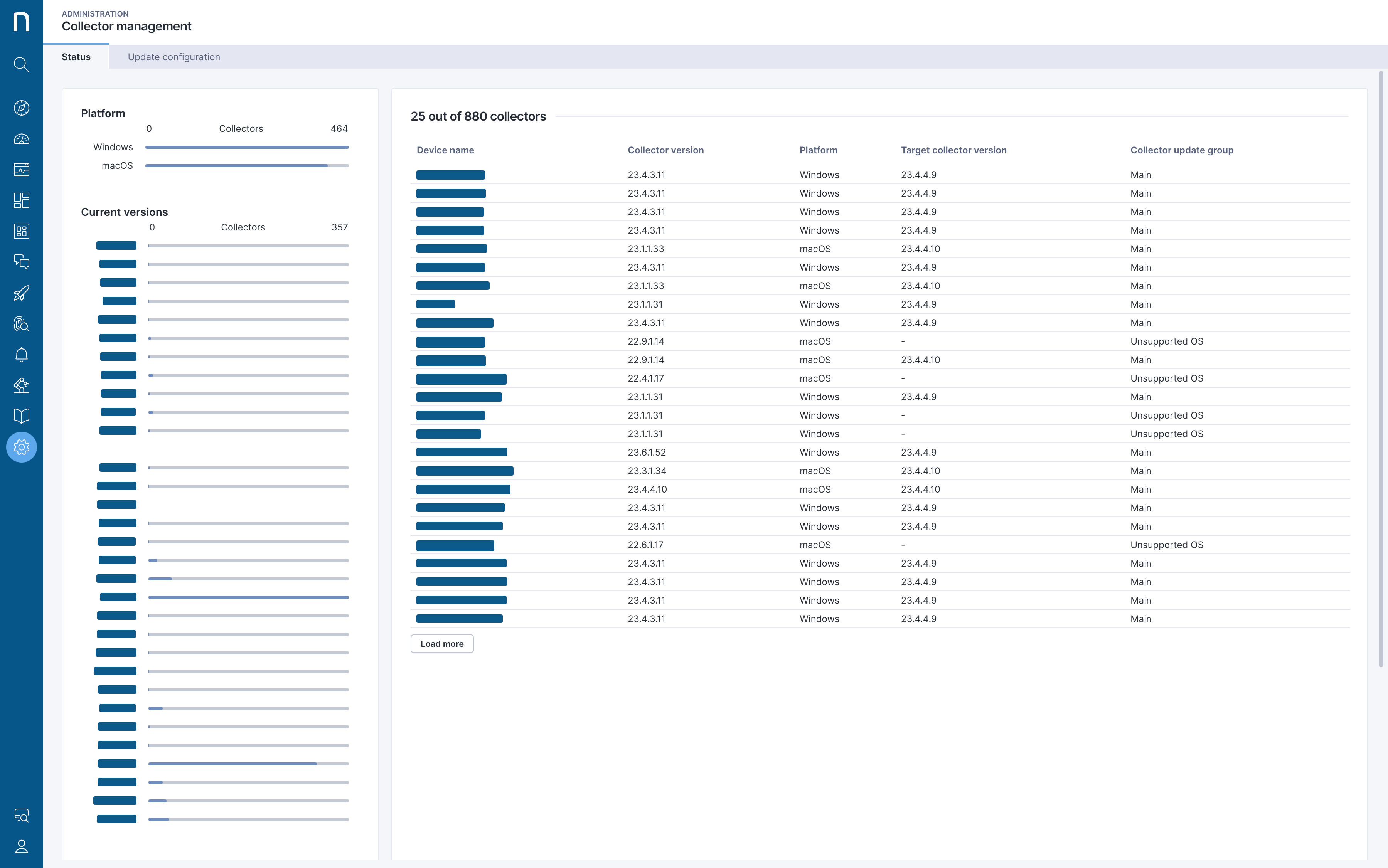
The status bar charts display information by platform, current versions, groups and target versions.
Click on the individual bars to filter the results that appear in the status table.
* **Platform**: View Collector instances deployed to specific platforms. Currently, Collector supports Windows, macOS and IGEL platforms.
* **Current versions**: This bar chart shows all current versions deployed in your organization.
* **Groups**: There are the following groups of Collector instances:
* The pilot group starts making updates two days after a new Collector version is available. By default, it includes 10% of the Collector instances, chosen randomly. Refer to the [Update Configuration](/user-guide/administration/system-configuration/collector-management/update-configuration.md) page for more information about customizing the pilot group.
* The main group represents the remaining Collector instances and the system updates them 16 days after a new Collector version is available. Refer to the [Update Configuration](/user-guide/administration/system-configuration/collector-management/update-configuration.md) page for more information about how to customize the main group and target the groups automatically.
* The unsupported OS group includes all the devices running Collector versions that cannot be updated as the host operating system is no longer supported. See the [software requirements](/configuring_nexthink/before-you-begin/technical-requirements/software-requirements.md) page for more information.
* When a VDI Connector is configured, the VDI group includes devices using non-persistent pooled or shared VDI types, as reported by the integration.
* **Target versions**: View the Collector versions that the system targets for automatic updates.
## Status table
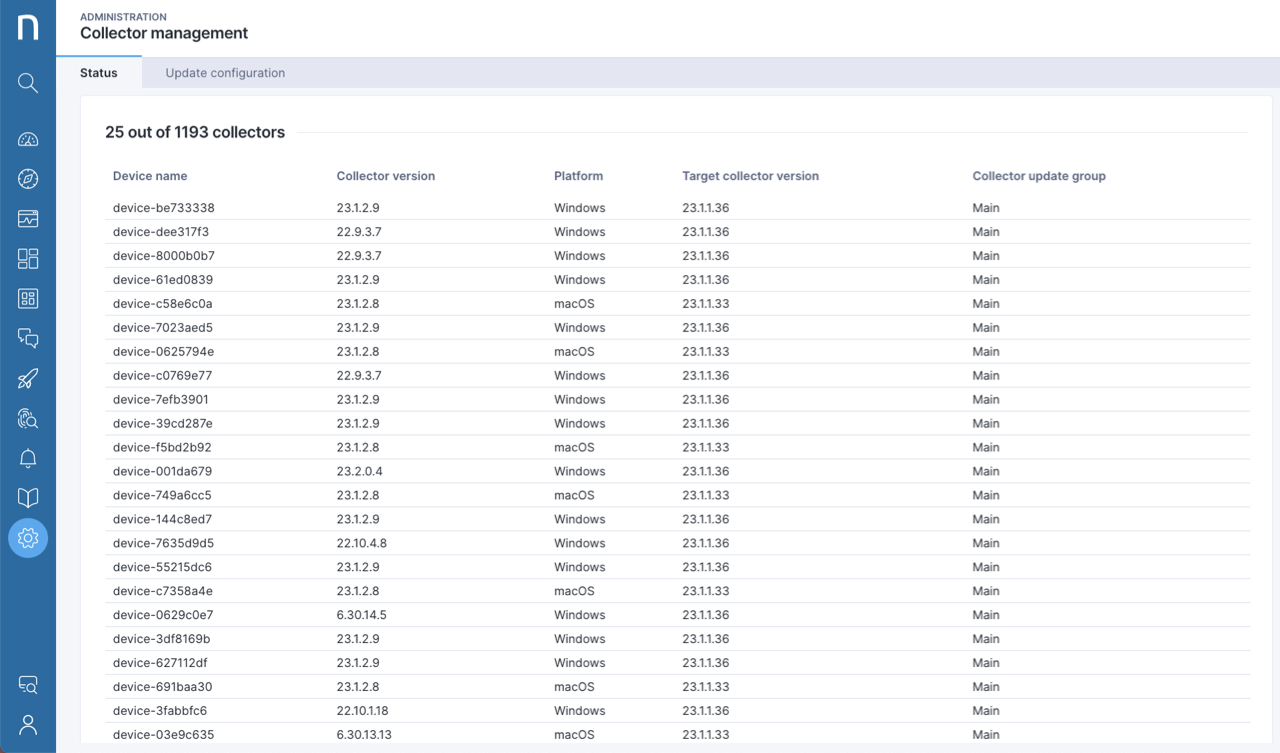
The status table lists the results of all the Collector instances according to the filters you applied to the page using the status bar charts. The system organizes table columns by the device name, collector version, platform and target Collector version.
---
# Agent Instructions
This documentation is published with GitBook. GitBook is the documentation platform designed so that both humans and AI agents can read, navigate, and reason over technical content effectively. Learn more at gitbook.com.
## Querying This Documentation
If you need additional information that is not directly available in this page, you can query the documentation by asking a question.
Perform an HTTP GET request on the following URL with the `ask` and `goal` query parameters:
```
GET https://docs.nexthink.com/user-guide/administration/system-configuration/collector-management/status.md?ask=&goal=
```
`ask` is the immediate question: it should be specific, self-contained, and written in natural language.
`goal` is what the user is ultimately trying to achieve, the reason they need the answer. Sharing it helps GitBook give you a better, more relevant answer. A goal is most helpful when it describes the outcome the user wants rather than restating the question. For example, with `ask=how do I create an API token`, a goal like `automate deployments from our CI pipeline` lets GitBook tailor the answer to that use case.
The response will contain a direct answer to the question and relevant excerpts and sources from the documentation.
Use this mechanism when the answer is not explicitly present in the current page, you need clarification or additional context, or you want to retrieve related documentation sections.