> For the complete documentation index, see [llms.txt](https://docs.nexthink.com/platform/llms.txt). Markdown versions of documentation pages are available by appending `.md` to page URLs; this page is available as [Markdown](https://docs.nexthink.com/platform/configuring_nexthink/bringing-data-into-your-nexthink-instance/integrating-nexthink-with-third-party-tools/outbound-connectors/webhooks/webhook-use-cases-setup/posting-a-message-in-zoom.md).
# Posting a message in Zoom
{% hint style="warning" %}
This documentation references external sources.
Nexthink does not control the accuracy of third-party documentation or external updates that can result in inconsistencies.
Report any errors or inconsistencies to [Nexthink Support](https://support.nexthink.com/).
{% endhint %}
This page demonstrates how to post a message to the video conferencing platform Zoom using a webhook.
## In Zoom
1. Complete the steps listed in the [Using Zoom's Incoming Webhook Chatbot](https://support.zoom.com/hc/es/article?id=zm_kb\&sysparm_article=KB0067640) documentation from Zoom.
2. Select **Manage your Workflow** to copy the URL and token for future reference for future reference. That is, for the [connector credential](#postingamessageinzoom-configuringaconnectorcredentialforzoomcredentialzoomtrue) and [webhook configuration](#postingamessageinzoom-configuringawebhookforzoomwebhookzoomtrue) in the Nexthink web interface:
* Endpoint URL example: `https://integrations.zoom.us/chat/webhooks/incomingwebhook/dSUXXXXXXXXXXXXXXXXXXX`
* Verification Token example:\
`PRuXXXXXXXXXXXXXXXXXXXX`
{% hint style="info" %}
The URL and verification token examples above are just for illustration purposes.
{% endhint %}
## In Nexthink
From the Nexthink web interface:
* [Configure a connector credential for the webhook](#postingamessageinzoom-configuringaconnectorcredentialforzoomcredentialzoomtrue)
* [Configure and test the webhook to post messages in a Zoom chat](#postingamessageinzoom-configuringawebhookforzoomwebhookzoomtrue)
### Configuring a connector credential for Zoom
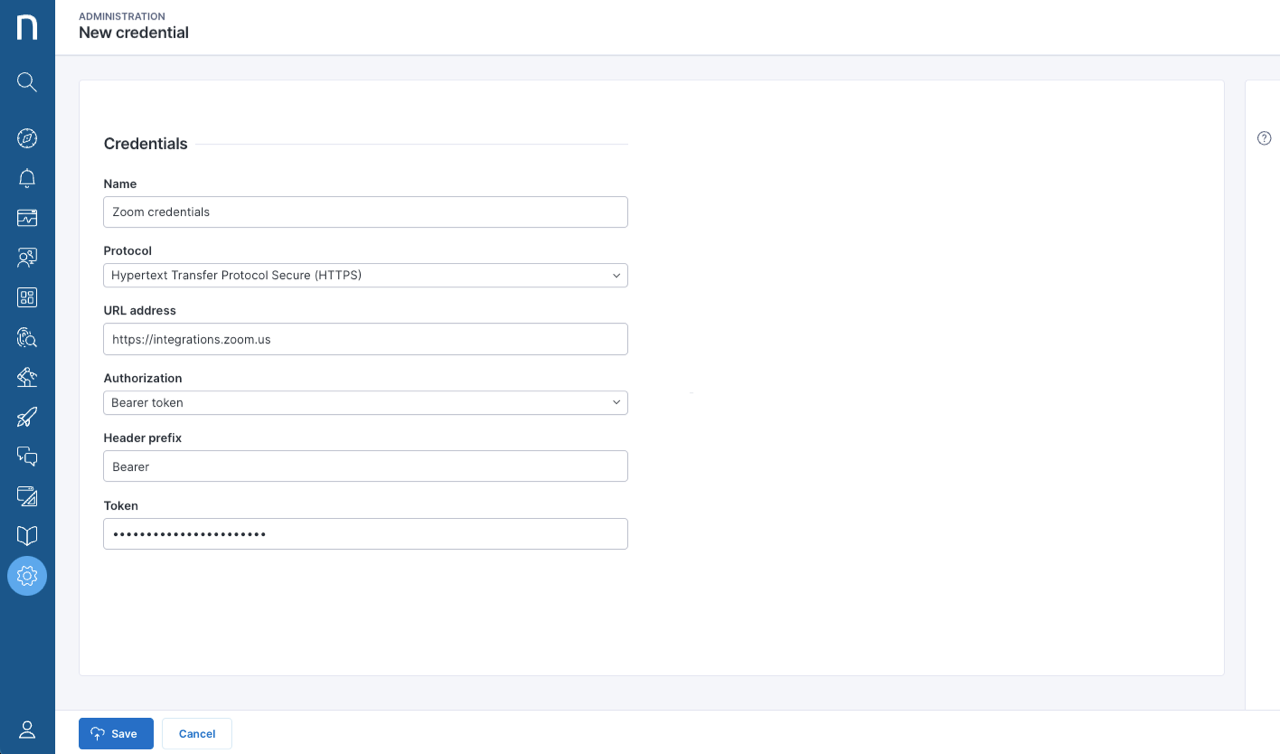
From the [connector credential](/platform/configuring_nexthink/bringing-data-into-your-nexthink-instance/integrating-nexthink-with-third-party-tools/outbound-connectors/connector-credentials.md) configuration page, fill out the fields using the information from the connection you created in Zoom.
1. Choose the **HTTPS** option from the **Protocol** drop-down.
2. Paste the root `https://integrations.zoom.us` into the **URL address** field.
3. Choose the **Bearer token** option from the **Authorization** drop-down.
4. Type in `Bearer` in the **Header prefix** field.
5. Copy the verification token from the Zoom connection and paste it into the **Token** field.
6. **Save** the credential.
### Configuring a webhook for Zoom
From the [webhook configuration page](/platform/configuring_nexthink/bringing-data-into-your-nexthink-instance/integrating-nexthink-with-third-party-tools/outbound-connectors/webhooks/managing-webhooks.md), fill out the fields using the information from the connection you created in Zoom and the connector credential defined in Nexthink.
1. Fill in the **NQL Condition** following the [Configuring webhook NQL conditions](/platform/configuring_nexthink/bringing-data-into-your-nexthink-instance/integrating-nexthink-with-third-party-tools/outbound-connectors/webhooks/managing-webhooks/configuring-webhook-nql-conditions.md) documentation. See the query below.
* After filling in the NQL Condition, the system lists the [allowed placeholders](/platform/configuring_nexthink/bringing-data-into-your-nexthink-instance/integrating-nexthink-with-third-party-tools/outbound-connectors/webhooks/managing-webhooks/configuring-webhook-fields_-method-resource-and-payload.md#configuringwebhookfields-method-resource-andpayload-usingdatamodelvariablesasplaceholdersinthepayloa) for the **Payload**.
```
alert.alerts
| where monitor.tags contains "web-applications"
| where alert.context contains "*Salesforce*" or alert.context contains "*Microsoft*"
| list alert.monitor.name, alert.status, monitor.tags, alert.context, trigger_time, recovery_time, alert.monitor.thresholds, monitor.priority, alert.trigger_values, alert.trigger_reference_value, alert.recovery_values, alert.context, device_view_link, issue_view_link, device.name
```
2. Choose the [connector credential](#postingamessageinzoom-configuringaconnectorcredentialforzoomcredentialzoomtrue) you created for Zoom from the **Credentials** drop-down.
3. Select the **POST** from the **Method** drop-down.
4. Copy and paste into the **Resources** field, the URL endpoint from the Zoom connection without the URL address. For example: `chat/webhooks/incomingwebhook/dSUXXXXXXXXXXXXXXXXXXX`
5. Add the message you want to send in **Payload**.
* Refer to [Using Zoom's Incoming Webhook Chatbot](https://support.zoom.com/hc/es/article?id=zm_kb\&sysparm_article=KB0067640) to confirm the payload formats supported by Zoom. For example, when adding the `?format=full` query parameter, you can create complex messages like:
```
{
"content": {
"head": {
"text": "This is an issue created by a Nexthink Alert",
"sub_head": {
"text": "Nexthink Alert {{alert.monitor.name}} has been triggered"
}
},
"body": [
{
"type": "message",
"text": "Alert for device {{device.device.name}}"
}
]
}
}
```
{% hint style="info" %}
Refer to the [Configuring webhook fields: Method, Resource, and Payload](/platform/configuring_nexthink/bringing-data-into-your-nexthink-instance/integrating-nexthink-with-third-party-tools/outbound-connectors/webhooks/managing-webhooks/configuring-webhook-fields_-method-resource-and-payload.md#configuringwebhookfields-method-resource-andpayload-usingdatamodelvariablesasplaceholdersinthepayloa) to learn more about allowed placeholders for payloads.
{% endhint %}
8. **Sent test** and verify the message appears in Zoom.
***
RELATED TOPICS
* [Connector credentials](/platform/configuring_nexthink/bringing-data-into-your-nexthink-instance/integrating-nexthink-with-third-party-tools/outbound-connectors/connector-credentials.md)
* [Managing webhooks](/platform/configuring_nexthink/bringing-data-into-your-nexthink-instance/integrating-nexthink-with-third-party-tools/outbound-connectors/webhooks/managing-webhooks.md)
* [Configuring webhook NQL conditions](/platform/configuring_nexthink/bringing-data-into-your-nexthink-instance/integrating-nexthink-with-third-party-tools/outbound-connectors/webhooks/managing-webhooks/configuring-webhook-nql-conditions.md)
---
# Agent Instructions
This documentation is published with GitBook. GitBook is the documentation platform designed so that both humans and AI agents can read, navigate, and reason over technical content effectively. Learn more at gitbook.com.
## Querying This Documentation
If you need additional information that is not directly available in this page, you can query the documentation dynamically by asking a question.
Perform an HTTP GET request on the current page URL with the `ask` query parameter, and the optional `goal` query parameter:
```
GET https://docs.nexthink.com/platform/configuring_nexthink/bringing-data-into-your-nexthink-instance/integrating-nexthink-with-third-party-tools/outbound-connectors/webhooks/webhook-use-cases-setup/posting-a-message-in-zoom.md?ask=&goal=
```
`ask` is the immediate question: it should be specific, self-contained, and written in natural language.
`goal` is optional and describes the broader end goal you are ultimately trying to accomplish on behalf of the user. GitBook uses it to tailor the answer towards what is most useful for that goal.
The response will contain a direct answer to the question and relevant excerpts and sources from the documentation.
Use this mechanism when the answer is not explicitly present in the current page, you need clarification or additional context, or you want to retrieve related documentation sections.